
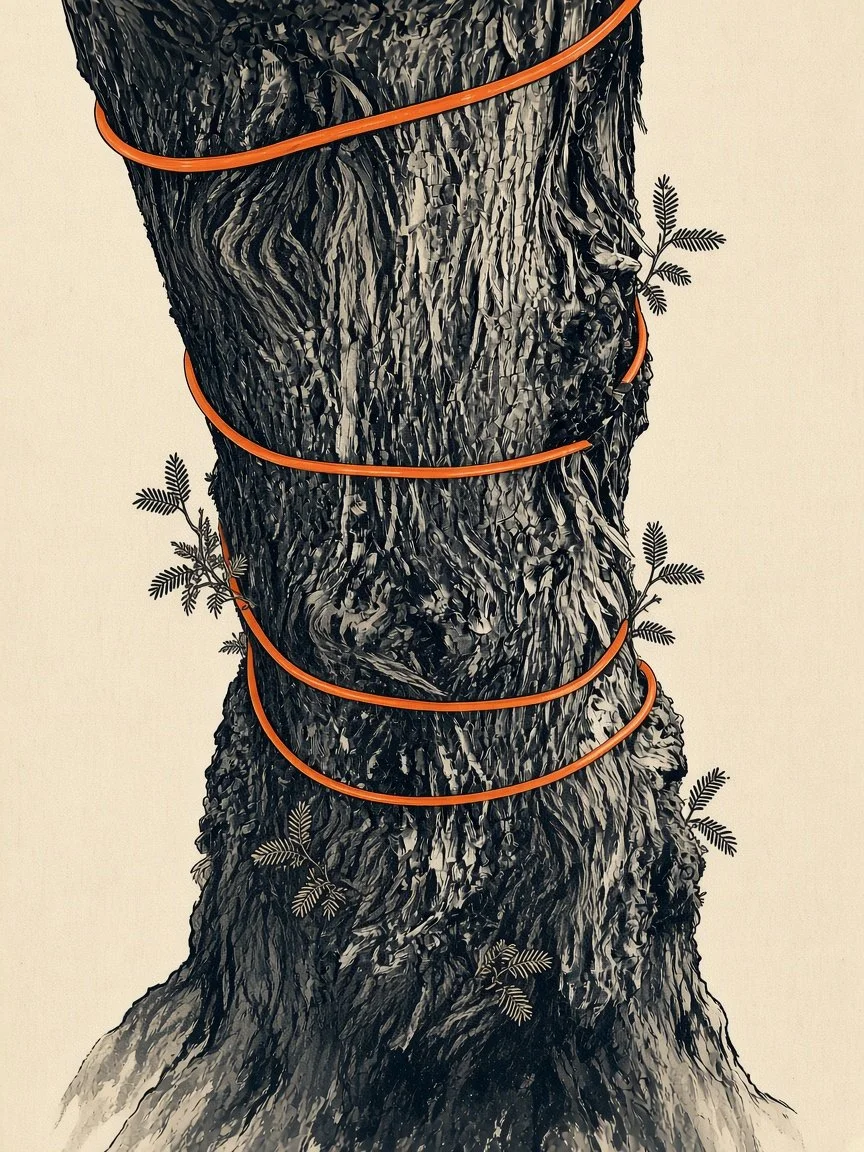
Trunk of a landscape tree (appears to be mesquite) with several loops of wire or lighting wrapped tightly around it, and sprouts forming around the wire.
Summary
Wire, nursery tape, staking ties, hose, rope and even string trimmer line left around a trunk or limb will eventually strangle it as the tree grows. The bark and water-conducting layer just under it get squeezed, so the part above the ring starves and weakens and often breaks there. It is entirely preventable and usually fixable if caught early.
Key symptoms
- Wire, tape or a tie visible around the trunk or a limb, or a deep groove where one has been engulfed.
- Swelling of wood just above (and sometimes below) the ring.
- Sprouts, dieback or poor growth above the constriction.
- In advanced cases, the limb snaps at the ring.
Likely causes, ranked
- Nursery ties and tapes left on after planting.
- Staking ties and wires never removed once the tree established.
- Wire used for lights, signs, fences or bracing wrapped around a trunk or limb.
- Rope, hose or trimmer line left on the trunk.
Look-alikes and how to tell them apart
- Girdling roots: constriction at or below the soil line from a root, not a manmade material (see Girdling & Circling Roots guide).
- Graft union: a natural ridge or change in bark near the base of grafted trees, with no groove.
- Branch bark ridge or old pruning scar: normal bark features, not a full ring.
What to check on site
- Every trunk and main limb, including under mulch and up in the canopy, for wire, tape, ties or rope.
- How deeply the material has been engulfed.
- Swelling, cracks, sprouts or dieback beyond the ring.
- Whether the weakened point is over a target.
Treatment
- Remove the material carefully. Cut loose wire or ties without gouging the bark.
- If it is deeply embedded, cut away what you can reach and leave buried pieces in place rather than carving into the wood.
- Assess the limb or trunk for strength at the ring; reduce weight or remove the limb if it is badly constricted and over a target.
- Staking: use wide, flexible ties, set loose, and remove stakes once the tree can stand (usually within a year or so).
What to expect and how to monitor
- Once freed, the tree usually grows new wood over the groove within a few seasons.
- Check young trees at every visit for ties and stakes, and older trees for forgotten wire.
Worried about a tree? Text Justin, ISA Certified Arborist, at (520) 451-8790 or email Justin@TimberxTrees.com. TIMBERx serves Tucson, Oro Valley, Marana, Vail, Sahuarita, Green Valley and Benson.
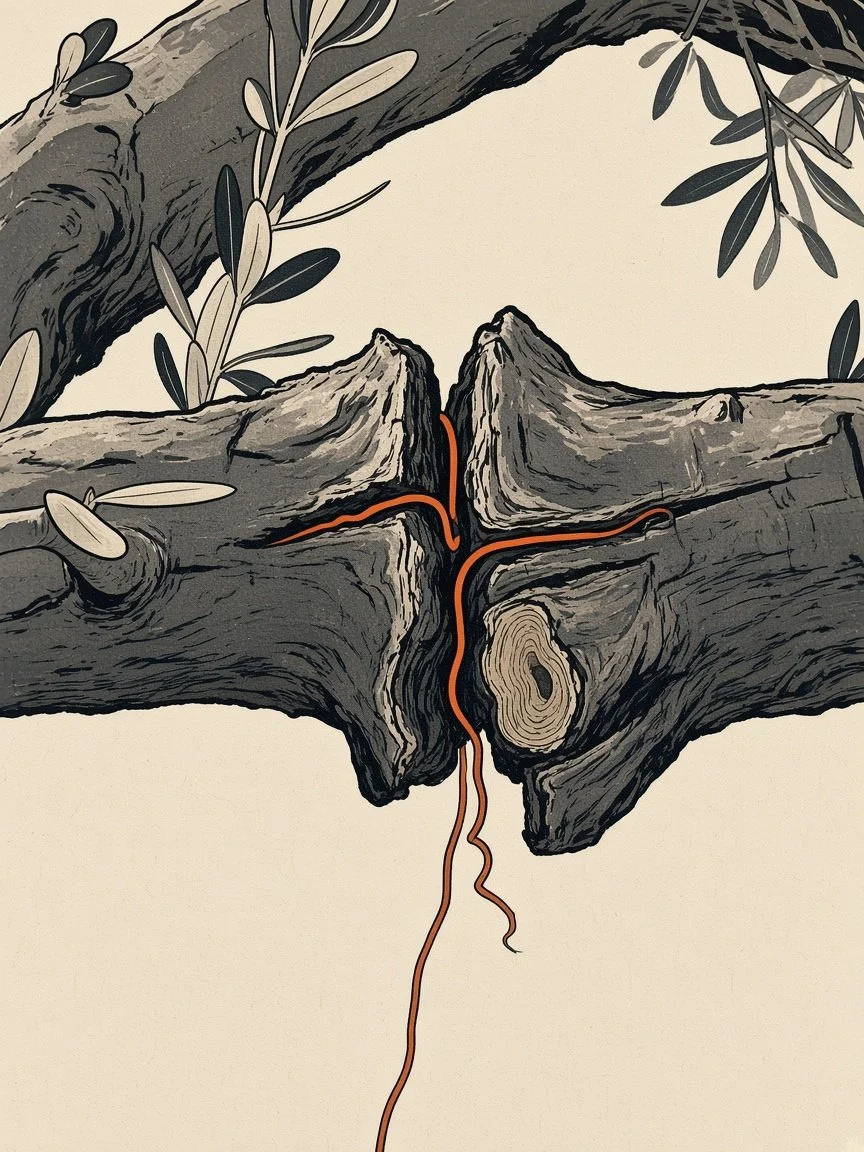
Olive (Olea europaea) limb with a deep constriction where a wire was left on; the wood has swollen on both sides of the ring and the wire still hangs below.
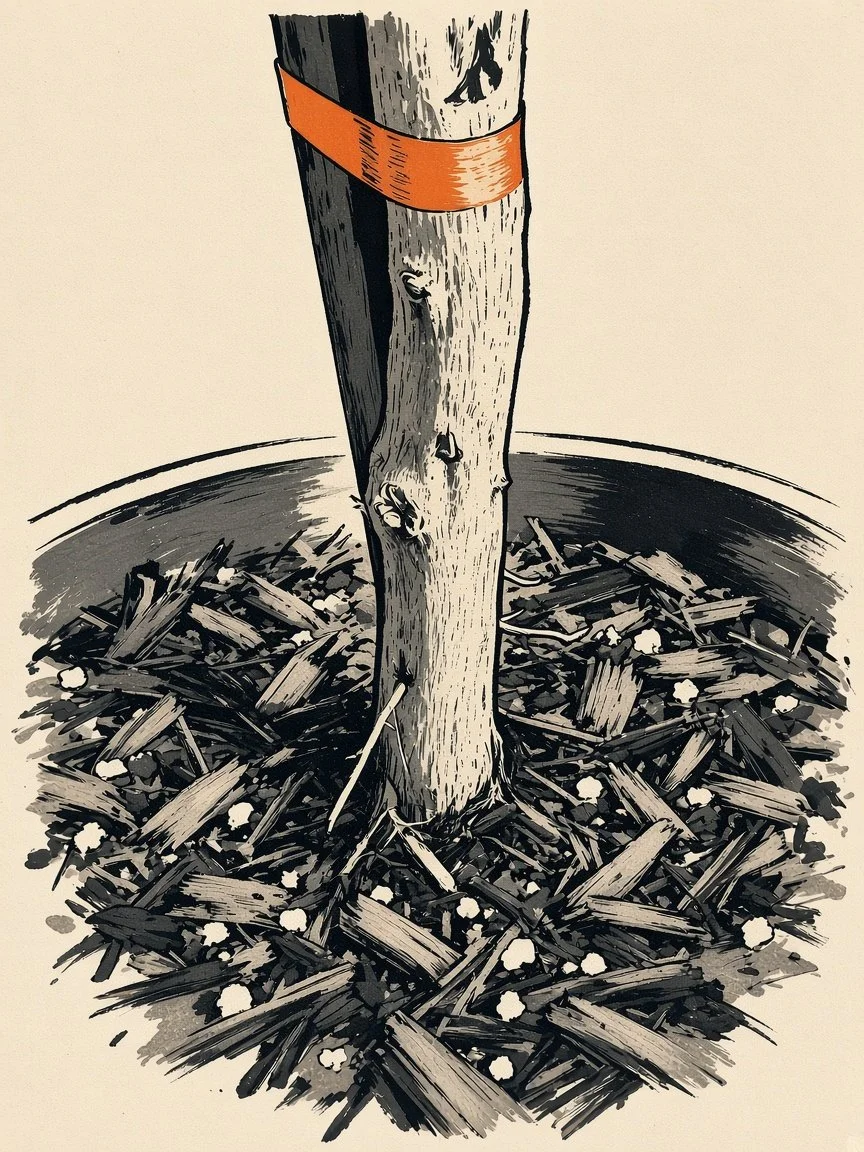
Young container tree with a nursery tie tape still around the trunk. Remove these after planting before they cut in.
