
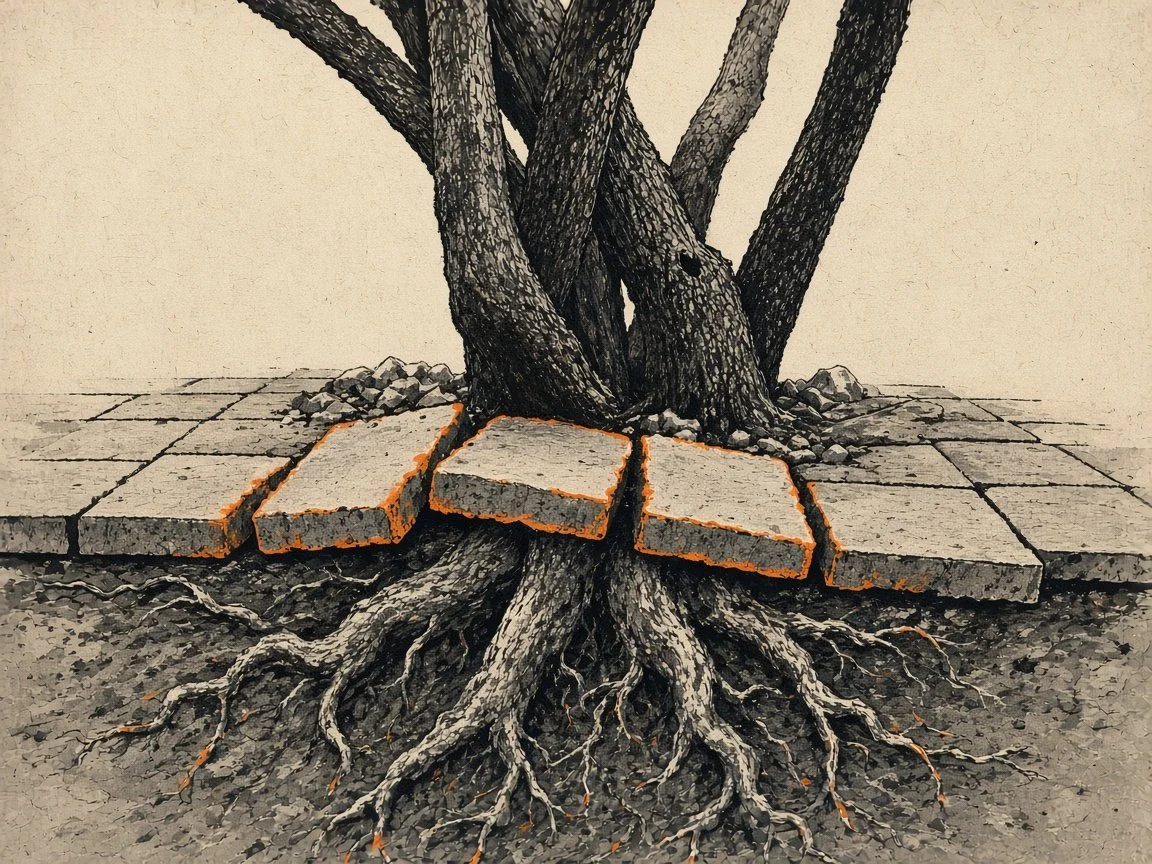
Multi-trunk landscape tree (species not confirmed) growing beside a paver patio; pavers nearest the trunk are tilted and lifted above their neighbors.
Summary
Tree roots grow where water, air and loose soil are easiest to find. In Tucson, that is often the moist, sandy base right under pavers, slabs and walkways, especially when irrigation or rain runoff collects there. As those roots thicken, they lift and tilt pavers, crack slabs and curbs, and can push against walls. The goal is to fix the hardscape and trip hazard while keeping enough of the root system that the tree stays healthy and stable.
Key symptoms
- Pavers or slab sections tilted, lifted or out of line, worst nearest the tree.
- Widening joints or cracks radiating toward the trunk.
- Visible roots at the surface or in joints along the edge of the hardscape.
- Tree trunk crowded against a patio edge, wall, fence or curb.
Likely causes, ranked
- Roots following moisture under hardscape. Pavers trap moisture and the sand base is easy to root into, so roots concentrate there.
- Tree planted too close to paving or walls. The trunk and buttress roots simply outgrow the space available.
- Shallow, frequent watering. Light watering keeps the roots in the top few inches instead of growing deeper (see Exposed Surface Roots - Shallow Watering).
- Compacted or caliche soil around the tree. Roots cannot grow down or out, so they go sideways under the softest material.
Look-alikes and how to tell them apart
- Settling or washout: pavers that sink rather than lift, usually where water runs or the base was poorly compacted, with no roots under them.
- Expansive soil movement: cracking spread over a wide area, not focused toward a tree.
- Girdling roots: roots wrapping the trunk itself rather than running out under paving (see Girdling & Circling Roots).
What to check on site
- Lift one or two pavers near the tree to see root size, depth and direction.
- Measure how far the lifted area is from the trunk; roots close to the trunk are the most important for stability.
- Note tree size, lean and how many main roots run under the hardscape.
- Check irrigation layout and where water collects.
- Look for trip hazards and any pressure on walls, footings, pipes or utilities.
Treatment
- Reset pavers over the roots: remove the lifted pavers, lower or reshape the base around roots, and relay them; pavers are easier on trees than poured slabs.
- Bridge or reroute: for walkways, a slightly raised path, flexible paving, or rerouting around the root zone avoids cutting.
- Root pruning only with care: an arborist should decide whether any root can be cut. Cutting large roots close to the trunk can destabilize the tree or cause decline. Clean cuts, as few as possible, as far from the trunk as possible.
- Root barriers can be installed along new hardscape edges to guide roots down, but they are a prevention tool, not a fix for existing large roots.
- Move water deeper and farther out: water deeply and less often at and beyond the drip line so roots grow there instead of under the patio.
- Long term: plan new plantings farther from paving and walls, sized for the space when mature.
What to expect and how to monitor
- Reset pavers may lift again over the years as roots grow; that is normal and can be re-leveled.
- After any root cutting, watch for canopy thinning, dieback or new lean over the next one to two years.
- Re-check before monsoon season, when wet soil and wind put the most strain on a tree with reduced roots.
Worried about a tree? Text Justin, ISA Certified Arborist, at (520) 451-8790 or email Justin@TimberxTrees.com. TIMBERx serves Tucson, Oro Valley, Marana, Vail, Sahuarita, Green Valley and Benson.

Patio pavers next to the same tree with uneven joints and raised edges, typical of roots growing just under the base material.
