
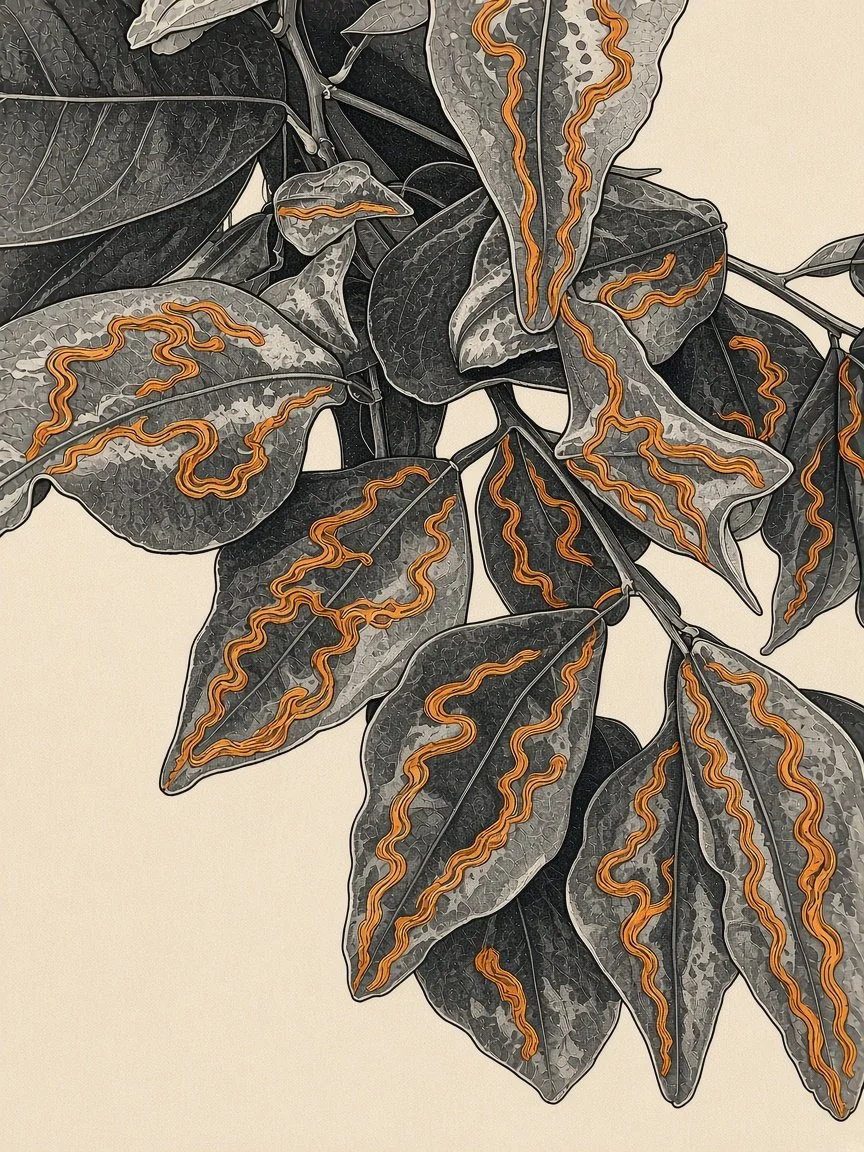
Citrus leaves showing damage from citrus thrips and citrus leafminer feeding.
Summary
Citrus thrips and citrus leafminer are two of the most common pests on backyard citrus in southern Arizona. Both attack the tender new flush of leaves. Thrips scrape the surface and leave scarred, distorted leaves (and scarring on young fruit), while leafminer larvae tunnel inside leaves, leaving silvery winding trails and curled new growth. On established trees the damage is mostly cosmetic. Young trees with little leaf area are where it matters more.
Key symptoms
Citrus thrips
- Silvery or grey scarring on leaf surfaces, often along the midrib.
- Thickened, curled, cupped or distorted new leaves.
- Ring-shaped or scabby scarring around the stem end of young fruit.
Citrus leafminer
- Silvery, winding (serpentine) trails inside the leaf, often with a thin dark line of waste down the middle.
- Curled or rolled new leaves, sometimes with a tiny pupal cell at the leaf edge.
- Damage only on young, soft leaves; mature leaves aren't attacked.
Likely causes, ranked
- Citrus leafminer feeding during the flush periods, especially the late-summer and fall flushes.
- Citrus thrips feeding on new leaves and young fruit, mostly in spring and early summer.
- Both together, which is common, giving a mix of scarring, mines and distortion.
Look-alikes and how to tell them apart
- Nutrient chlorosis: yellow between green veins in a regular pattern, no trails or scarring (see Citrus Chlorosis guide).
- Citrus leaf yellowing from nitrogen or root stress: evenly pale or yellow leaves, normal shape (see Citrus Leaf Yellowing guide).
- Wind or sun damage: scuffed or bleached areas on exposed sides, no mines.
- Mites: fine stippling, sometimes webbing, and a dull or bronzed look to leaves.
What to check on site
- Look at new flush first: mines (leafminer) versus surface scarring and distortion (thrips).
- Hold a leaf up to the light to see winding mines.
- Young fruit for ring scarring.
- Tree age and size: young trees are more affected.
- Pruning and fertilizing schedule, since frequent out-of-season flushes give pests more food.
Treatment
- On mature trees, damage is mostly cosmetic, and treatment often isn't needed.
- Leave damaged leaves on the tree; they still make food. Don't strip or prune them off.
- Time care with the flush: avoid heavy pruning and fertilizing that push lots of tender growth in late summer, when leafminer pressure is highest.
- Protect beneficial insects that keep both pests in check by avoiding broad-spectrum sprays.
- Young trees with heavy damage: a product labeled for citrus and these pests can be used on new flush, following the label exactly. An arborist can help decide whether it's worth it.
What to expect and how to monitor
- Damaged leaves stay marked, but new flushes come out clean once pest pressure drops.
- Check each flush (spring, summer, fall) for new mines and scarring.
- Healthy, well-watered citrus usually outgrows the damage with little effect on overall health or fruit production.
Worried about a tree? Text Justin, ISA Certified Arborist, at (520) 451-8790 or email Justin@TimberxTrees.com. TIMBERx serves Tucson, Oro Valley, Marana, Vail, Sahuarita, Green Valley and Benson.
