
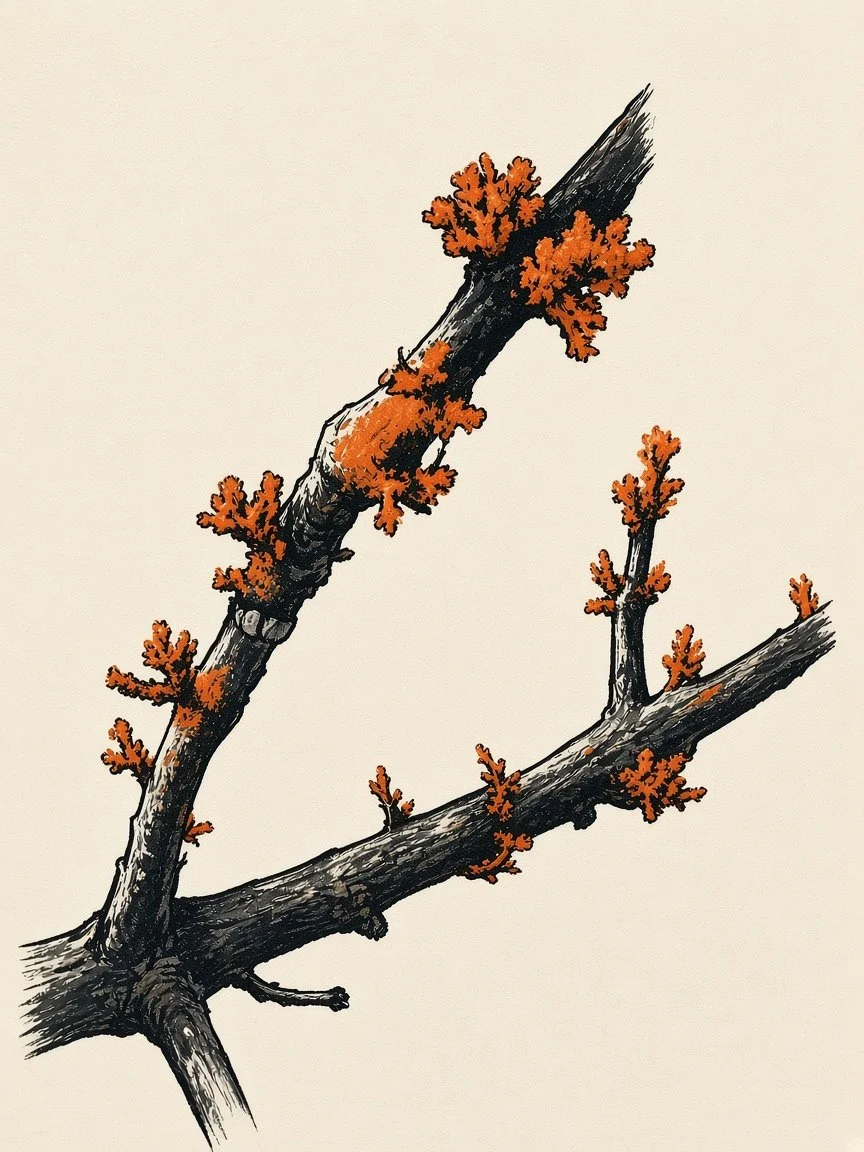
Bottle tree (Brachychiton populneus) with clusters of short, crowded, knobby growth at the nodes (witches' broom) after herbicide exposure. This tree eventually had to be replaced.
Summary
Some lawn and weed herbicides act like plant growth hormones. When a tree takes them up, through spray drift onto leaves or through roots that extend under treated turf or gravel, new growth can come out distorted: clusters of short, crowded shoots, swollen knobby nodes, and twisted or cupped leaves. This bunched growth is called witches' broom. Trees exposed once and lightly can grow out of it, but repeated or heavy exposure often leaves a tree that never recovers its normal form or vigor.
Key symptoms
- Clusters of many short shoots from one point (witches' broom).
- Swollen, knobby nodes and twigs.
- New leaves that are small, narrow, twisted, cupped or strap-like.
- Distortion concentrated in new growth, often on the side facing the treated area.
- Thinning canopy and dieback over time with repeated exposure.
Likely causes, ranked
- Herbicide moving through the soil and roots from weed control on gravel, turf or nearby beds. Tree roots usually spread well past the canopy.
- Spray drift onto leaves and green stems during windy or hot conditions.
- "Weed and feed" lawn products applied over the tree's root zone.
- Soil sterilant products used along driveways, walls or gravel areas.
Look-alikes and how to tell them apart
- Witches' broom from insects, mites or disease: usually scattered brooms on otherwise normal growth, not all new growth affected at once.
- Basal suckers and water sprouts: vigorous, normal-looking shoots, not stunted and distorted (see Basal Suckers guide).
- Freeze damage: dead tips and blackened tissue after a cold snap, without crowded, knobby growth.
- Nutrient deficiency: yellowing patterns on normally shaped leaves (see Citrus Chlorosis guide).
What to check on site
- Pattern: is distortion on all new growth, or on one side facing a treated area?
- Weed control history around the tree: turf, gravel, beds, neighbors' yards, and how far from the trunk.
- Other plants nearby with similar distortion, which points to herbicide.
- How much of the canopy is affected and whether new growth is still coming out distorted.
- Overall vigor and dieback.
Treatment
- Stop the source: end use of herbicides in the root zone, which extends well past the drip line. Hand-pull or use non-chemical weed control near trees.
- Deep watering helps the tree grow out of a light exposure; don't fertilize heavily to "push" new growth.
- Prune out dead wood, but wait to see how new growth develops before removing distorted shoots in bulk.
- Prevention: keep any herbicide off windy days, follow labels exactly, and avoid products labeled with warnings about use near trees and shrubs.
Why recovery is often poor, and when replacement makes sense
- Some of these herbicides persist in soil and keep being taken up, so damage can continue for several seasons.
- Repeated exposure weakens the tree and distorts its structure.
- Consider replacement when the tree has been declining for more than a season or two, most new growth is still distorted, or dieback is spreading. Before replanting, confirm the source has stopped so the new tree isn't exposed the same way.
What to expect and how to monitor
- Check each new flush of growth: normal-shaped leaves and shoots mean recovery is underway.
- Expect slow recovery for a light exposure and possible decline for heavy or repeated exposure.
Worried about a tree? Text Justin, ISA Certified Arborist, at (520) 451-8790 or email Justin@TimberxTrees.com. TIMBERx serves Tucson, Oro Valley, Marana, Vail, Sahuarita, Green Valley and Benson.
