
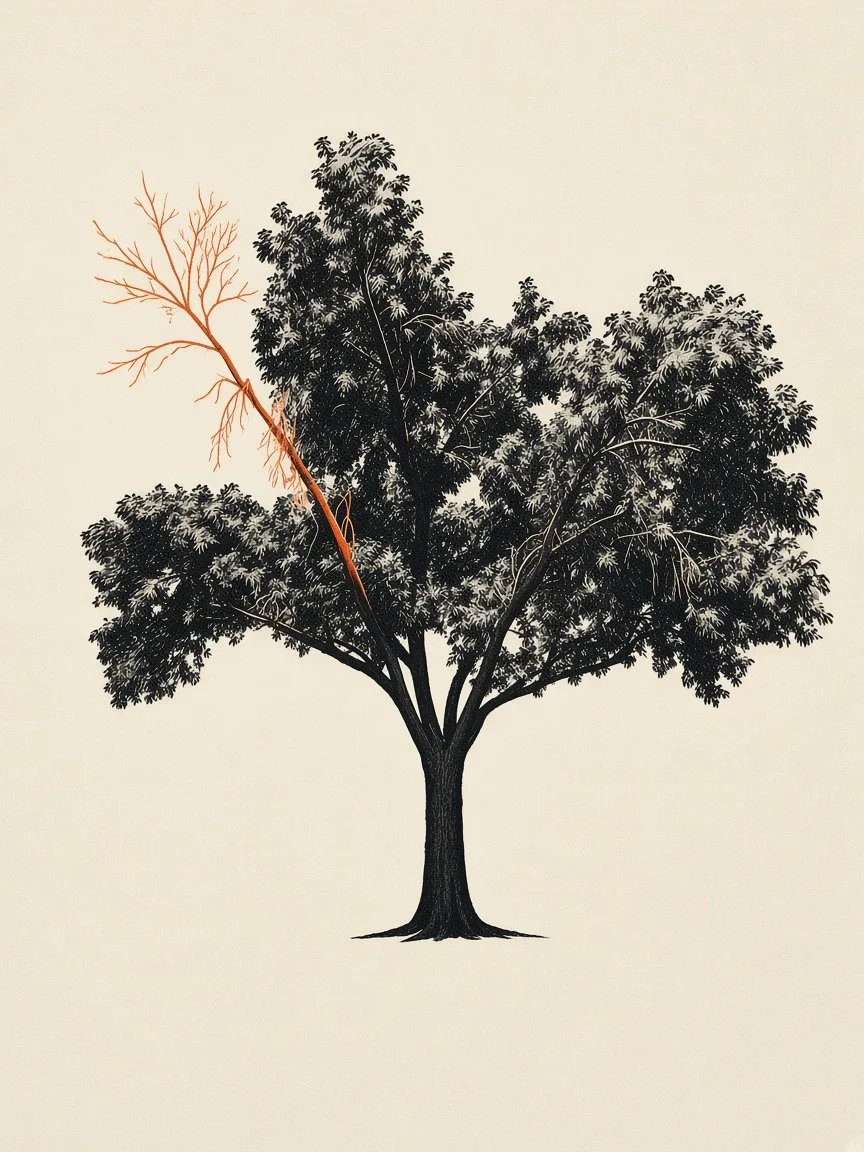
Mature shade tree in a backyard (Arizona ash, Fraxinus velutina), with bare, leafless branch at the top of one side of an otherwise green canopy.
Summary
Dieback means branches dying back from their tips, leaving bare, leafless twigs, usually at the top or outer edge of the canopy. It is a symptom, not a single disease: in Tucson it is most often caused by water stress and heat, root problems, or an attack by borers or canker on stressed wood. The pattern of the dieback and the condition of the trunk and roots point to the cause.
Key symptoms
- Bare, brittle twigs and small branches with no leaves, while the rest of the canopy is green.
- Usually starts at branch tips and at the top of the crown (the farthest points from the roots).
- May be on one side or one section of the tree, or scattered across the crown.
- Sometimes leaves on nearby branches are small, sparse or pale.
Likely causes, ranked
- Water stress and heat. Too little water reaching the root zone, especially through the June heat, causes the tree to shed its farthest-out branches first. Most common in Tucson.
- Root damage or root loss. Trenching, new hardscape, grade changes, compaction or girdling roots on one side often show up as dieback on the matching side of the canopy.
- Borers and cankers. Wood-boring beetles and canker fungi attack already stressed branches; look for exit holes, oozing, cracked or sunken bark.
- Old pruning wounds or broken limbs that let decay into a branch.
- Freeze damage after a hard frost, showing in spring on frost-sensitive species.
Look-alikes and how to tell them apart
- Normal interior shedding: shaded inner twigs die as the tree grows; harmless and found inside the canopy, not at the top.
- Seasonal leaf drop: whole tree drops leaves evenly at once; twigs stay flexible and green under the bark.
- Mistletoe: clumps of leafless green or reddish stems in the canopy, often with branch decline past the clump.
- Scratch a twig with a thumbnail: green underneath is alive; brown and dry is dead.
What to check on site
- Pattern: one side vs. scattered vs. whole crown; matching the side of any root disturbance.
- Watering: emitter count, placement and run time; probe soil depth after watering.
- Trunk and major limbs: borer exit holes, sap flow, cracks, cankers, sunscald.
- Root flare: girdling roots, soil or gravel piled against the trunk, damage.
- Recent history: construction, irrigation changes, hard freeze, heavy pruning.
Treatment
- Prune out dead wood back to live tissue, cutting just outside the branch collar. Removing dead wood reduces hazard and borer habitat.
- Correct watering: deep, infrequent irrigation that reaches beyond the drip line, especially before and during the hottest months.
- Protect the root zone: stop further disturbance, relieve compaction where possible, and add coarse mulch (kept off the trunk).
- Hold off fertilizing a stressed tree until water and roots are sorted out.
- If borers or cankers are found, remove infested wood and focus on tree vigor; consult before any chemical treatment.
What to expect and how to monitor
Dead branches will not recover. Judge success by whether new dieback stops and new growth is healthy.
Recheck after the summer heat and the following spring. Progressive dieback despite better watering points to root or trunk problems and needs a closer inspection.
Worried about a tree? Text Justin, ISA Certified Arborist, at (520) 451-8790 or email Justin@TimberxTrees.com. TIMBERx serves Tucson, Oro Valley, Marana, Vail, Sahuarita, Green Valley and Benson.

Citrus (fruiting; type not confirmed) with thin, sparsely leaved shoots dying back at the top of the canopy while the lower canopy stays full.
