
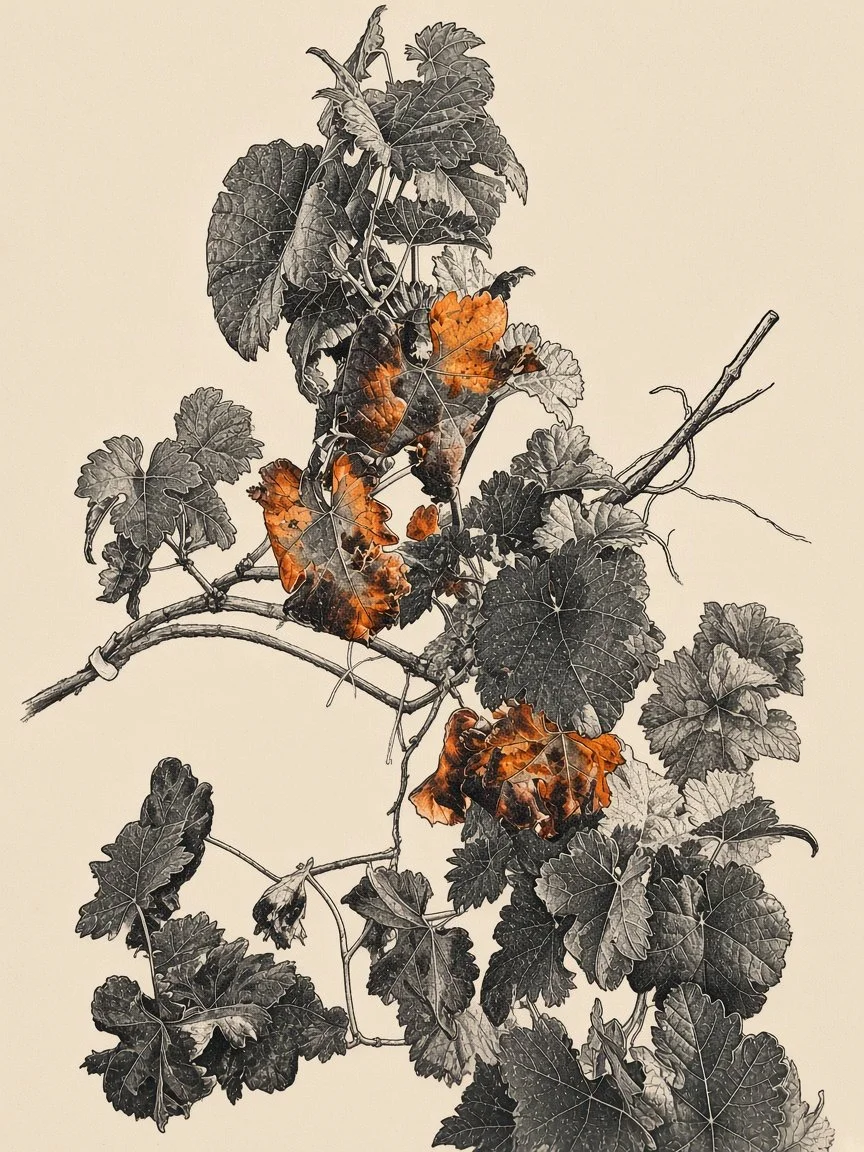
What is visible
Red-purple color and browning occur on several leaves, with some green veins/central areas and green leaves nearby.
Some margins are curled and dry rather than simply changing color.
The image does not show an entire vine comparison, fruit condition, persistent bare petioles, cane maturation or roots.
Likely causes, ranked provisionally
Autumn senescence, possibly with old heat or moisture injury. Grapes are deciduous; color and leaf loss vary with cultivar and microclimate. November timing, Justin's report of recent onset and remaining green leaves strengthen the seasonal-change explanation, with late-season scorch a possible contributor. Extensive crisp tissue deserves checking rather than being dismissed as normal. This moves down the ranking if symptoms began well before fall or production declined.
Water deficit, salt stress or limited/impaired roots. Tucson's heat and dry winds can leave older leaves scorched; drip coverage may not match a mature vine's roots. Salt and fertilizer accumulation, root restriction or saturated soil can produce similar marginal injury. A picture cannot distinguish “needs more water” from root damage in wet soil.
Pierce's disease (Xylella fastidiosa), an important rule-out, not a diagnosis. Red/yellow margins progressing inward to brown can resemble this photo. Supporting clues include premature leaf drop leaving petioles attached (“matchsticks”), irregular cane maturation with green islands in brown wood, preharvest raisining, reduced vigor and recurrence. None is demonstrated here. Their absence from a single photograph does not exclude disease. Confirm through a plant diagnostic lab before removal decisions.
Grapevine leafroll or red blotch disease. Leafroll can produce interveinal reddening with green major veins and downward rolling; red blotch can also redden major veins, especially beneath leaves. Cultivar, timing and laboratory testing are needed. Red leaves do not identify a virus.
Nutrient imbalance, cold or spray injury. Potassium-related marginal injury and magnesium-related interveinal color can overlap other disorders; feeding without tissue/soil evidence may worsen salinity. An actual frost, recent spray or sudden exposure change would alter the ranking.
Look-alikes and on-site investigation
Leaf color alone cannot establish the cultivar. Establish vine age, planting/rootstock history, the exact recent onset date and whether this occurred last year.
Photograph the whole vine, neighboring vines, both leaf surfaces and the complete length of affected shoots. Compare older and young leaves and sunny versus sheltered sides.
Inspect for matchstick petioles and patchy cane maturation. Inspect fruit history: normal ripening versus unusually shriveled clusters and delayed sugar development. These combinations are more informative than leaf color alone.
Check dripper flow, wetted width/depth, soil drainage and actual moisture. Review fertilizer, herbicide and irrigation-water history. Test salinity when the history supports it.
For persistent or early-season symptoms, ask Arizona Cooperative Extension/a plant diagnostic lab about sampling for Pierce's disease and relevant grape viruses. Follow the lab's season, tissue and transport instructions; a negative sample from unsuitable tissue is not a universal clearance.
Use appropriately timed leaf/petiole testing with grape-specific interpretation for suspected nutrition issues. Do not prescribe potassium, magnesium or iron from color alone.
Treatment now
If this is recent fall color with normal annual growth/fruiting: allow normal leaf fall. Do not try to keep a deciduous vine green with fertilizer or heavy watering.
If moisture delivery is inadequate: correct emitters and irrigate the active root zone according to measured moisture and drainage; adjust downward as demand falls. Do not irrigate already saturated soil just because foliage is brown.
If salts are documented: remove unnecessary fertilizer inputs and plan drainage-dependent leaching with suitable water. Avoid a fixed flushing schedule or untested amendments.
While disease is unresolved: do not propagate or distribute cuttings from the symptomatic vine. Do not remove the vine on this photo alone. If Pierce's disease is confirmed, there is no curative homeowner spray; discuss removal/replacement and local vector management with Extension. Confirmed virus management likewise requires diagnosis and clean replacement stock rather than a “leaf tonic.”
Avoid blanket pesticides. Red/purple foliage is not a pest identification. Use only a demonstrated target and an edible-grape label if treatment becomes justified.
Preserve useful foliage until normal leaf fall. Schedule cultivar-appropriate dormant pruning, not a severe attempt to “cut out” a systemic disease.
Monitoring and homeowner takeaway
Keep a dated record through leaf fall and next spring. Normal bud break, vigor and healthy leaves next season support a seasonal/abiotic explanation but do not alone exclude latent infection. Recurrent scorch, poor bud break, crop decline or the disease clues above warrant testing promptly. A grapevine with fall color needs context; it does not automatically need fertilizer, a fungicide or removal.
