
Example photographs
Key symptoms
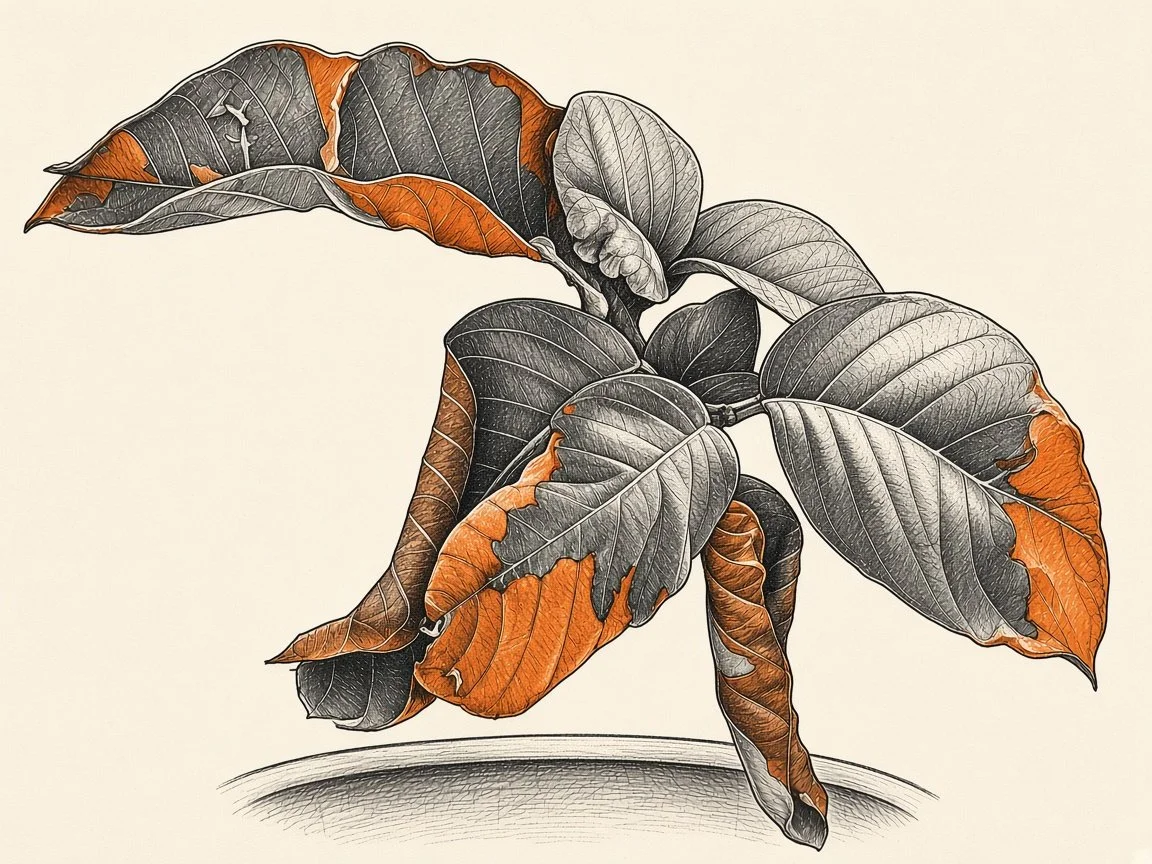
Many leaves have dry tan-to-rust-brown margins or distal sections with a green central or basal area.
Leaves are curled; several appear more damaged than adjacent foliage.
The plant is in a container, which limits water storage and exposes roots to rapid temperature and moisture changes.
Likely causes, ranked provisionally
Cold/chilling stress — promoted to a co-leading working possibility. Sudden onset during a period of cooler nights raises its relevance. Tropical guava can respond adversely to nonfreezing cold; frost is not required for chilling stress. The plant has not moved, so a recent relocation/acclimation shock is not supported. However, “cooler nights” alone cannot establish either the dose of cold or the cause of the brown tissue. No actual minimum or duration is known, and the photo does not show a cold-specific diagnostic pattern. This provisional first position is a priority for investigation, not evidence that cold is more probable than water stress.
Acute root-ball water deficit, potentially interacting with cold or dry wind. A missed irrigation, blocked emitter or dry center can produce abrupt scorch even if the plant's location has not changed. A peat-based mix can channel water down the pot wall while its center stays dry. Check the entire root ball before assuming cold or increasing water. This remains co-leading until moisture and timing are established; historic summer heat is less satisfactory as the sole explanation for newly sudden injury.
Salt or fertilizer injury. Tip/marginal burn remains consistent with irrigation salts, concentrated fertilizer or poor drainage. Gradual accumulation alone fits sudden onset less well than a discrete event, but a fertilizer application or drying episode can trigger acute symptoms. No fertilizer event, salinity measurement or water-source change has been supplied.
Root impairment: restriction or persistently wet, poorly aerated medium. These can reduce uptake and mimic drought. Cooler weather reduces water use, so an unchanged summer watering schedule can leave a pot wet longer. No root rot or root-bound condition is confirmed; inspect before repotting or adding water.
Spray injury, pests or infectious leaf disease. These remain lower on the present evidence and would rise with a matching treatment history, live pests, expanding separate spots or diagnostic lesions. Brown margins alone do not identify a pathogen.
Chilling is not the same as freezing — what the sources actually support
Chilling is injury from low temperatures above 32°F (0°C); freeze injury involves freezing. University of Georgia Extension explains that tropical/subtropical plants are particularly susceptible, with reddish/purple discoloration, wilting, browning or leaf loss possible depending on the plant and exposure. A guava-specific peer-reviewed review reports that nights around 41–45°F (5–7°C) can stop growth and turn guava leaves purple. That is evidence of a nonfreezing cold response, not a universal brown-leaf threshold, and reddening can also be part of acclimation rather than irreversible injury.
UF/IFAS notes that guava growth slows below about 60°F; growth slowing is not proof of tissue damage. Likewise, published freezing-survival temperatures are not temperatures below which all earlier cold injury suddenly begins. Cultivar, acclimation, duration, hydration and leaf/root exposure matter. Container roots have less soil-temperature buffering than roots in the ground, making monitoring and protection important, but a container alone does not establish chilling injury. Do not apply postharvest fruit-storage thresholds to living leaves or prescribe a single guaranteed injury temperature for this plant.
Look-alikes and site checks
Dry versus wet root ball: test several depths and positions, including the center, before and after watering. Surface mulch can look dry while the pot remains wet. Note drainage time and whether water bypasses the center.
Salts versus drought: record fertilizer formulation, amount and timing, water source and any softened-water use. If recurrent, test irrigation water and potting medium electrical conductivity through an appropriate lab; a generic soil test may not assess the container medium correctly.
Root restriction versus root rot: with the pot supported, inspect roots gently without tearing them. Dense circling roots suggest restriction; dark soft decaying roots with persistent saturation suggest root disease or oxygen deprivation and justify diagnostic help. Root color alone is not sufficient.
Cold versus water/salt injury: record the exact sudden-onset date and compare it with measured overnight minima and hours of exposure at canopy/pot level, not just a distant airport reading. Log temperatures before future cool nights and compare sheltered versus exposed foliage and nearby plants. Justin confirms no relocation; do not use a move into full sun as this case's explanation. Verify root-ball moisture around the same period.
Disease versus scorch: photograph fresh injury fronts and undersides with a scale. Record whether new discrete spots expand independently of the margin and whether nearby plants have the same pattern.
Treatment in a safe order
Correct what the moisture check finds. If dry, thoroughly and slowly wet the entire root ball, allowing drainage; repeat carefully if water initially channels past dry mix. If wet, verify open drain holes, remove standing saucer water and correct the saturated conditions before adding more water.
Pause fertilizer while the cause is unresolved. Do not add fertilizer to force browned foliage to green up. Avoid softened irrigation water where practicable. Never add gypsum or another amendment solely because edges are brown.
Leach only when drainage is working and excess soluble salts are supported by history/testing. Use suitable low-salt water and let leachate drain away, not back into a saucer. Do not repeatedly flush an already waterlogged pot. Investigate persistent problems rather than applying a fixed leaching schedule.
Match the container to the root system. If restriction is confirmed, plan repotting or planting with appropriate medium/site and careful root correction. Do not tear apart or severely root-prune a stressed plant on a guess.
Reduce avoidable extremes. Shelter from desiccating wind and intense reflected afternoon heat while retaining adequate light; acclimate gradually to changed exposure. Monitor forecasts and local minima, and protect tropical guava from damaging nonfreezing cold as well as frost when conditions warrant it. Shelter the pot/root zone and canopy while retaining suitable light and drainage; do not wait for a freeze warning as the only trigger. Use supported frost cloth where appropriate, not plastic touching foliage; recognize that cloth gives limited protection during prolonged cold. Avoid forcing tender growth with late fertilizer. Reassess watering with measured moisture as growth slows; do not abruptly dry the plant or keep its pot saturated.
Keep functioning green leaves. Dead tissue will not recover. Remove fully dead material as appropriate, but avoid heavy pruning or stripping the canopy while stressed. No fungicide or insecticide is indicated without an identified target and an edible-crop label.
Monitoring and escalation
Mark a few leaves and photograph weekly for several weeks. Improvement means no fresh marginal burn and healthy new leaves when growth resumes — not repair of old edges. Cooler weather can slow new growth. Seek an on-site assessment if wilt persists despite verified suitable moisture, injury progresses into shoots, roots are decaying or the trunk shows a lesion. If a disease is suspected, arrange sampling before treatment.
Sources
University of Georgia Cooperative Extension — Effects of Low Temperature on Plants, Bulletin 1467 (general chilling/freezing distinction, symptoms and container-root protection).
Fischer and Melgarejo, 2021 — Ecophysiological aspects of guava: a review, temperature section (guava purple-leaf/growth response at nonfreezing temperatures; not a universal necrosis threshold).
UF/IFAS — Guava: cold sensitivity, container stock and site considerations
UF/IFAS — Guava Growing in the Florida Home Landscape (physiology reference; Florida schedules are not Tucson irrigation prescriptions)
