
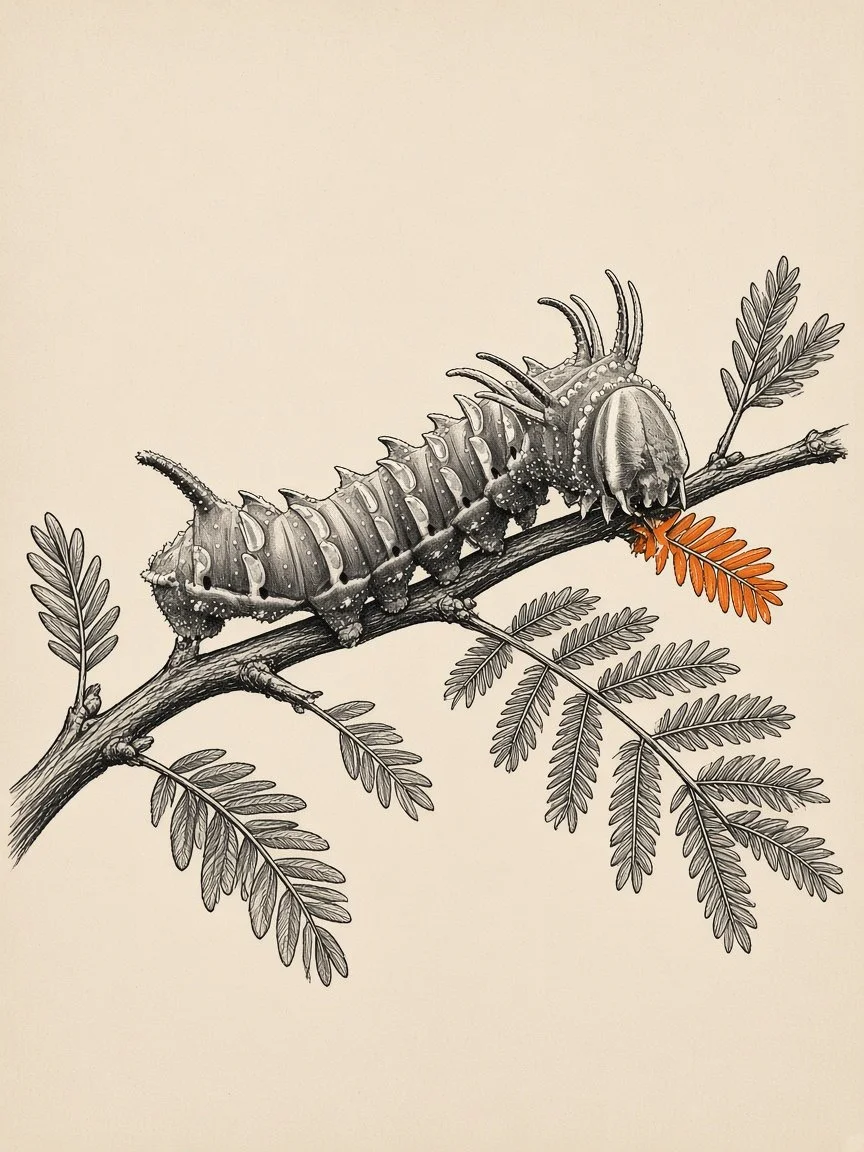
royal moth caterpillar
Summary
This bright green, horned caterpillar is the young of a royal moth (genus Sphingicampa, also listed as Syssphinx), a native silk moth that feeds on legume trees such as mesquite, palo verde and acacia. The Tucson species is most likely Hubbard's silk moth (S. hubbardi), which is known to have caterpillars here into November. The mesquite next to where this one was found strengthens that ID (about 75–80% confidence), but the species is not confirmed. It looks fierce, but the horns and silver spines are for show: it does not sting or bite. In this case a mesquite, a recorded host, was growing right beside the Texas ebony, so the caterpillar most likely fed on the mesquite and moved onto the ebony, possibly while searching for a place to pupate. Texas ebony is not a confirmed host for this species. Full-grown caterpillars leave their host in fall and dig into the soil to spend the winter as a pupa. Feeding on mesquite and other legume hosts is light and cosmetic on established trees.
Key symptoms
A plump green caterpillar up to about 2 inches long with four long, curved horns behind the head, often banded yellow and purple-brown.
Rows of short silver or white spines along the back, and a pale yellow-and-white stripe edged in red along each side.
A green head with pale stripes, and a single longer spine near the tail end.
Missing leaflets or bare leaf stems on a few twigs; older caterpillars may chew partway through a leaf stem and bend it down to feed.
Small dark droppings (frass) on the ground or pavement below.
In fall, caterpillars wandering on trunks, walls, the ground or gear, looking for soft soil to pupate in.
Likely causes, ranked
A nearby recorded host tree. Mesquite, palo verde and acacia are the recorded hosts. A caterpillar found on Texas ebony most likely came from one of these growing nearby; ebony is a pea-family relative but not a confirmed host.
Late-season generation. Several broods a year mean full-grown caterpillars still show up in October and November before they go into the soil for winter.
Wandering to pupate. Mature caterpillars crawl off their host onto nearby trees, walls and gear while looking for soft soil, which is how they turn up on non-host trees.
Look-alikes and how to tell them apart
Other royal moth species (S. albolineata, S. montana, S. raspa): very similar larvae that can only be split by close detail or by rearing to the adult moth. All are harmless and treated the same way.
Sphinx moth hornworms: green with diagonal side stripes and one stiff horn at the tail, no horns behind the head and no silver spines (see the Sphinx Moth Caterpillars guide).
Cloudless sulphur caterpillars: smooth, green-to-yellow with a yellow side stripe and tiny black dots, no horns or spines; they feed mostly on sennas.
Hairstreak caterpillars (such as Cyanophrys): small, flattened slug-shaped green larvae under half an inch, no horns.
Stinging slug and flannel moth caterpillars: hairy, furry or flat with no long horns. Those can sting, so do not handle a caterpillar unless you know what it is.
What to check on site
Which tree the caterpillar is actually feeding on. Look for chewed leaflets and frass under nearby mesquite, palo verde or acacia before blaming the tree it was found on.
How many caterpillars, and how much of the host canopy is chewed. A few bare twigs on a mature tree is normal.
Whether new growth is being stripped on a young or newly planted tree, the only case worth acting on.
Frass under the tree, to find caterpillars hiding in the canopy.
Other legume trees nearby, so you know where the moths are coming from.
Overall tree health: water depth, mulch and recent frost, so leaf loss isn't blamed on caterpillars when it's stress.
Treatment
Usually no treatment is needed. Leave them be; this is a native moth and the tree replaces the leaves.
Check cut branches when pruning in fall. Look over cut mesquite and other legume branches before chipping or hauling them, and move any caterpillars back onto the host tree.
Hand-pick or relocate caterpillars on a young tree. They don't sting or bite; move them to a mesquite or palo verde that can spare the leaves.
Bacillus thuringiensis (Bt kurstaki) sprayed on the leaves targets caterpillars only and is safe for bees, birds and people. Save it for a small tree with heavy feeding, and follow the label.
Avoid broad-spectrum insecticides. They kill the wasps, flies and birds that keep these caterpillars in check and can flare mites and scale.
Value them. Royal moths are part of the native food web: birds feed the caterpillars to nestlings, and the moths are rarely seen.
What to expect and how to monitor
Feeding is short and light; established trees show no lasting harm.
Full-grown caterpillars leave the tree on their own in fall to pupate in the soil, so don't disturb loose soil and mulch under the canopy over winter.
Birds, paper wasps and parasitic flies take many caterpillars on their own.
Check young trees every week or two from late summer into fall.
Call an arborist if a young tree keeps getting stripped, or if leaf loss continues after the caterpillars are gone, since that points to another problem.
