

Improved Meyer lemon (Citrus × meyeri ‘Improved’): full-size leaves with broad green bands along the midrib and main veins and soft, pale yellow-green tissue between them, even on both sides of the midrib.
Summary
This is micronutrient chlorosis, most likely manganese deficiency, possibly with zinc deficiency alongside it. Tucson's alkaline, high-calcium (caliche) soils lock up manganese, zinc and iron, so these shortages often show up together in citrus. It is very treatable, mainly with foliar micronutrient sprays and better root-zone conditions; judge success by the next flush of growth.
Key symptoms
- Leaves are normal, full size.
- A broad green band runs along the midrib and main lateral veins; the tissue between them is pale yellow-green.
- The contrast between green and yellow is soft, not sharp.
- The pattern is even and symmetrical on both sides of the midrib.
- Most visible on recently hardened (mature, not brand-new) leaves.
Likely causes, ranked
- Manganese (Mn) deficiency (most likely). Normal leaf size, soft contrast and wide green bands along the veins are the classic Mn picture.
- Zinc (Zn) deficiency, alone or with Mn. Zinc gives a sharper yellow-and-green mottle, and new leaves come in small, narrow and pointed, sometimes with short internodes and a rosetted, tufted look at shoot tips. Check the newest growth for this.
- Iron (Fe) chlorosis (less likely here). Iron shows first on the newest leaves as a fine green vein network over a pale yellow blade. These leaves are mature and the bands are broad, which argues against iron as the main problem.
- A root or water problem causing the deficiency. Wet, poorly drained or compacted soil, or a damaged root zone, cuts nutrient uptake even when nutrients are present. Meyer lemons are touchy about this, especially when flood-irrigated or planted in heavy soil.
- Unlikely: magnesium deficiency (a green inverted V at the leaf base on older leaves, yellowing from the tip and edges inward) or HLB / citrus greening (a lopsided, blotchy mottle that does not follow the veins; the even, symmetrical pattern here argues against it).
Look-alikes and how to tell them apart
| Condition | Which leaves | Pattern | Leaf size |
|---|---|---|---|
| Manganese deficiency | Recently hardened leaves | Broad green bands on veins, soft contrast | Normal |
| Zinc deficiency | New flush | Sharp yellow/green mottle | Small, narrow, pointed; rosetting |
| Iron chlorosis | Newest leaves | Fine green vein net on pale yellow blade | Normal to slightly small |
| Magnesium deficiency | Old interior leaves | Green inverted V at base; yellow from tip and edges | Normal |
| HLB (citrus greening) | Scattered | Blotchy, lopsided, ignores veins | Variable |
What to check on site
- Which leaves are affected: Mn on recently hardened leaves; Zn and Fe on new flush; Mg on old interior leaves.
- Newest leaves: size and shape (small, narrow, pointed = zinc).
- Soil moisture and drainage: soggy soil, a sour smell, caliche near the surface, soil or mulch piled against the trunk.
- Recent fertilizer: heavy phosphorus or manure can tie up zinc.
- Tests: a soil pH test, plus a leaf tissue test from 4 to 7 month old spring-flush leaves.
Treatment
- Foliar spray first. In alkaline soil, foliar feeding beats soil feeding for Mn and Zn. Use a citrus micronutrient spray (Mn, Zn and Fe sulfates or a chelated blend) at label rate.
- Timing: spray when a new flush is about two-thirds expanded, in the morning, with temperatures under about 85°F. Repeat on the spring flush and again on the summer or fall flush.
- Long term: lightly acidify the drip zone with soil sulfur, and use a citrus fertilizer that includes micronutrients. If iron is involved, use EDDHA chelated iron (the form that stays available in high-pH soil).
- Water: deeply and infrequently, out at the drip line rather than at the trunk. Pull soil and mulch back from the trunk.
What to expect and how to monitor
- Leaves that are already yellow will only partly green up. That is normal.
- Judge success by the next flush: it should come in fully green.
- Recheck at each flush (spring, summer/fall). If new growth still comes in pale or small, revisit drainage and root health and use the tissue test to confirm which nutrient is short.
Worried about a tree? Text Justin, ISA Certified Arborist, at (520) 451-8790 or email Justin@TimberxTrees.com. TIMBERx serves Tucson, Oro Valley, Marana, Vail, Sahuarita, Green Valley and Benson.
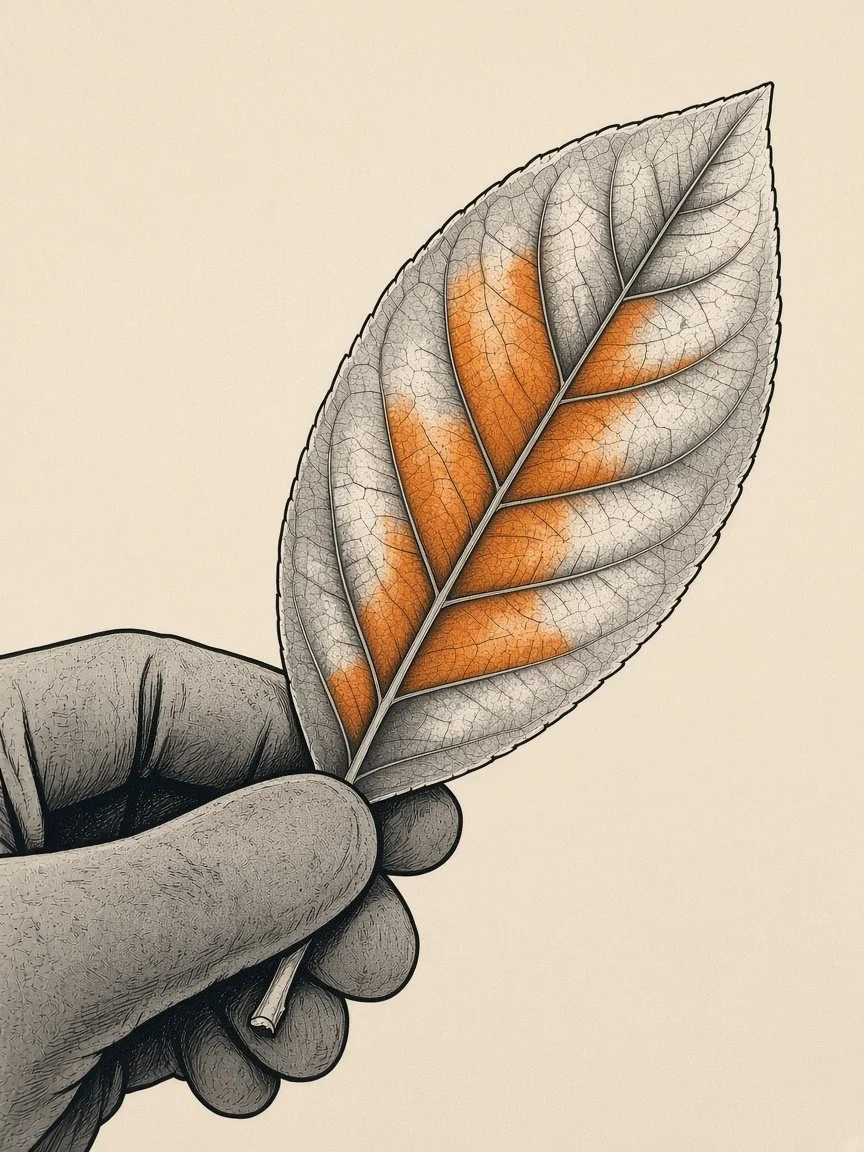
Citrus leaf (variety not confirmed) with green veins and yellow tissue between them, the interveinal pattern of a manganese or zinc shortage. The small black specks on the surface are a separate question (speculative: insect frass or young scale; check with a hand lens).
