
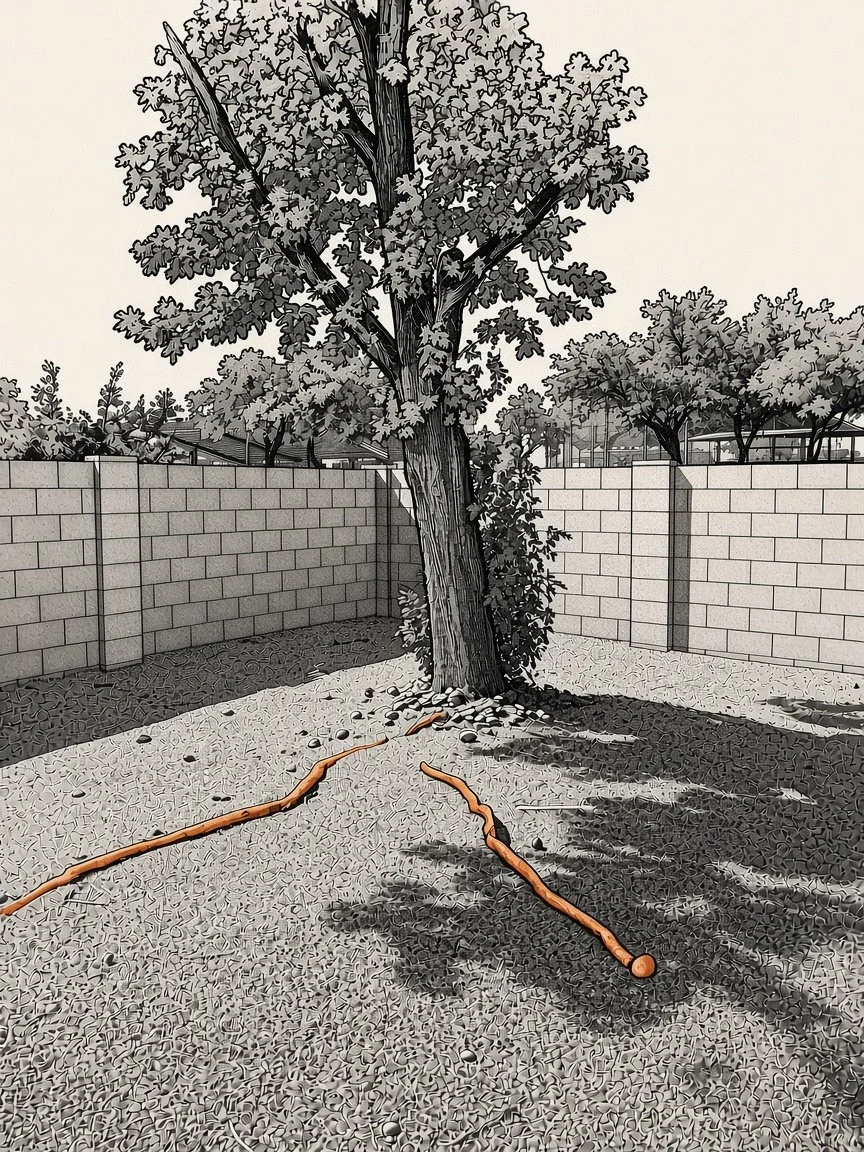
Mature Arizona Ash in a gravel yard, with long woody roots running across the soil surface away from the trunk.
Summary
Roots that run along or above the soil surface usually mean the tree has been watered shallowly and often, so roots stayed in the top few inches where the water was. In Tucson, hard or caliche-layered soil and gravel or decomposed-granite groundcover make this worse. Surface roots are not a disease, but they make the tree more drought- and heat-sensitive, less stable in monsoon winds, and easy to damage with mowing, foot traffic or digging.
Key symptoms
- Woody roots visible on or just above the soil surface, often running outward in long lines from the trunk.
- Roots may have scraped, sunburned or barked-off top surfaces.
- Often paired with emitters or sprinklers close to the trunk, and dry, hard soil just below the surface.
Likely causes, ranked
- Shallow, frequent irrigation. Short drip or sprinkler runs wet only the top few inches, so roots grow there. This is the most common cause in desert landscapes.
- Compacted or caliche soil. Roots cannot push down, so they spread sideways near the surface where there is air and water.
- Soil erosion or settling. Wind, monsoon runoff or raking of gravel slowly exposes roots that were originally buried.
- Species tendency. Ash, mulberry, eucalyptus, pine and some elms naturally root shallowly and show this sooner.
Look-alikes and how to tell them apart
- Girdling roots: these wrap around the trunk or root flare rather than running outward; look at the base of the trunk.
- Stem-encircling roots from nursery pots: circle close to the trunk; usually found by excavating the root flare.
- Root suckers: green shoots coming up from roots, not just exposed woody roots (see the Basal Suckers guide).
What to check on site
- Emitter count, location and run time; whether water reaches past the drip line and at least 18 to 24 inches deep (push a soil probe or long screwdriver in after watering).
- Soil hardness and caliche depth.
- Damage on exposed roots: wounds, decay, mower or vehicle scrapes.
- Any girdling or circling roots at the root flare.
- Lean, soil heaving or cracking on the side away from the lean (stability concern).
Treatment
- Change the watering, not the roots. Water deeply and less often, with emitters moved out to and beyond the drip line. Over time new roots develop deeper and farther out.
- Do not cut large surface roots to "clean up" the yard. Removing major roots can destabilize the tree and invite decay. Get an arborist to evaluate before any root cutting.
- Cover lightly with 2 to 4 inches of coarse organic mulch (not soil) to protect roots and moderate temperature. Do not pile soil over roots, and keep mulch off the trunk.
- Protect from traffic: route paths and mowing away from the root zone.
What to expect and how to monitor
- Existing surface roots will stay; the goal is protecting them and encouraging deeper rooting.
- Recheck soil moisture depth each season, and check the canopy and stability after monsoon storms.
Worried about a tree? Text Justin, ISA Certified Arborist, at (520) 451-8790 or email Justin@TimberxTrees.com. TIMBERx serves Tucson, Oro Valley, Marana, Vail, Sahuarita, Green Valley and Benson.
