

Oleander (Nerium oleander) on drip irrigation along a stone wall: crisp tan dead tips on many leaves across the canopy, a sharp line between dead and live tissue, and clean new leaves at the top of each whorl.
Summary
This is leaf tip burn from the root zone, not a disease: salts building up under drip irrigation, made worse by too little water reaching the roots of a plant that has outgrown its emitters. It is common across Tucson because our water carries dissolved salts and we get too little rain to flush them out. The fix is deep leaching and a drip upgrade, while making sure to rule out oleander leaf scorch.
Key symptoms
- A crisp, tan band of dead tissue at the leaf tips.
- A sharp line between dead and live tissue, with no yellow transition zone.
- Shows on many leaves across the whole canopy, older leaves first.
- The newest leaves at the top of each whorl are clean.
Likely causes, ranked
- Salt burn from drip with no leaching (most likely). Drip wets small spots. Salts from Tucson water collect at the edge of each wet zone, and there is little rain to flush them. The salts move into the leaves, concentrate at the tips and burn older foliage first.
- Not enough water for the plant's size. Mature oleanders outgrow their original emitters. Emitters near the trunk, or short frequent run times, leave the outer roots dry. A stone wall reflects and holds heat and can rob the root zone of water. The damage likely happened during the summer heat peak and is showing up now.
- Oleander leaf scorch (Xylella fastidiosa) - the one to rule out. A bacterial disease spread by sharpshooter insects, and eventually fatal. It usually starts on one or a few branches and spreads branch by branch, often with a yellow band between the brown and the green, and watering does not help. An even, sharp-edged burn across the whole plant argues against it.
- Fertilizer burn, or softened / high-sodium water. Produces the same tip-burn pattern.
Look-alikes and how to tell them apart
| Condition | Distribution | Edge of the burn | Response to water |
|---|---|---|---|
| Salt burn | Even across the plant, older leaves first | Sharp, no yellow band | Improves on new growth after leaching |
| Drought / under-watering | Even, worst on hot side | Sharp, crisp | Improves with deeper watering |
| Oleander leaf scorch | Starts on certain branches, spreads branch by branch | Often a yellow band between brown and green | No improvement; keeps spreading |
| Fertilizer or softened-water burn | Even, follows the application | Sharp | Improves once the source stops |
What to check on site
- Distribution: even across the plant points to salt or water; burn on certain branches is a red flag for scorch.
- Emitters: count, flow rate, run time, and position relative to the drip line. Dig or probe to see how wide and deep water actually reaches.
- Salt crust: white crust at the edges of the wet spots.
- Water source: a water softener or a well.
- Wall side vs. open side: compare burn on each.
- New growth: confirm it is coming in clean.
Treatment
- Leach the root zone: a deep, slow soak over the whole root area (a few inches of water from a trickling hose or soaker hose). Repeat about monthly through the hot season.
- Upgrade the drip: add emitters or move them out to the drip line, raise the gallons per cycle, and water longer but less often.
- Mulch to cut evaporation and salt wicking to the surface.
- Avoid fertilizer and softened water on this plant.
- Burned tips won't recover. Leave them or lightly shear them.
- If the burn is patchy by branch or keeps getting worse after leaching, send samples for a Xylella test (the University of Arizona Cooperative Extension can point you to a lab), and don't take cuttings until scorch is ruled out.
What to expect and how to monitor
- Existing brown tips stay brown; judge the fix by the next flush, which should come in clean.
- Recheck through the next hot season for new tip burn, and look for salt crust at the wet-zone edges.
- Watch for any branch-by-branch decline; that pattern means testing for leaf scorch.
Worried about a tree? Text Justin, ISA Certified Arborist, at (520) 451-8790 or email Justin@TimberxTrees.com. TIMBERx serves Tucson, Oro Valley, Marana, Vail, Sahuarita, Green Valley and Benson.
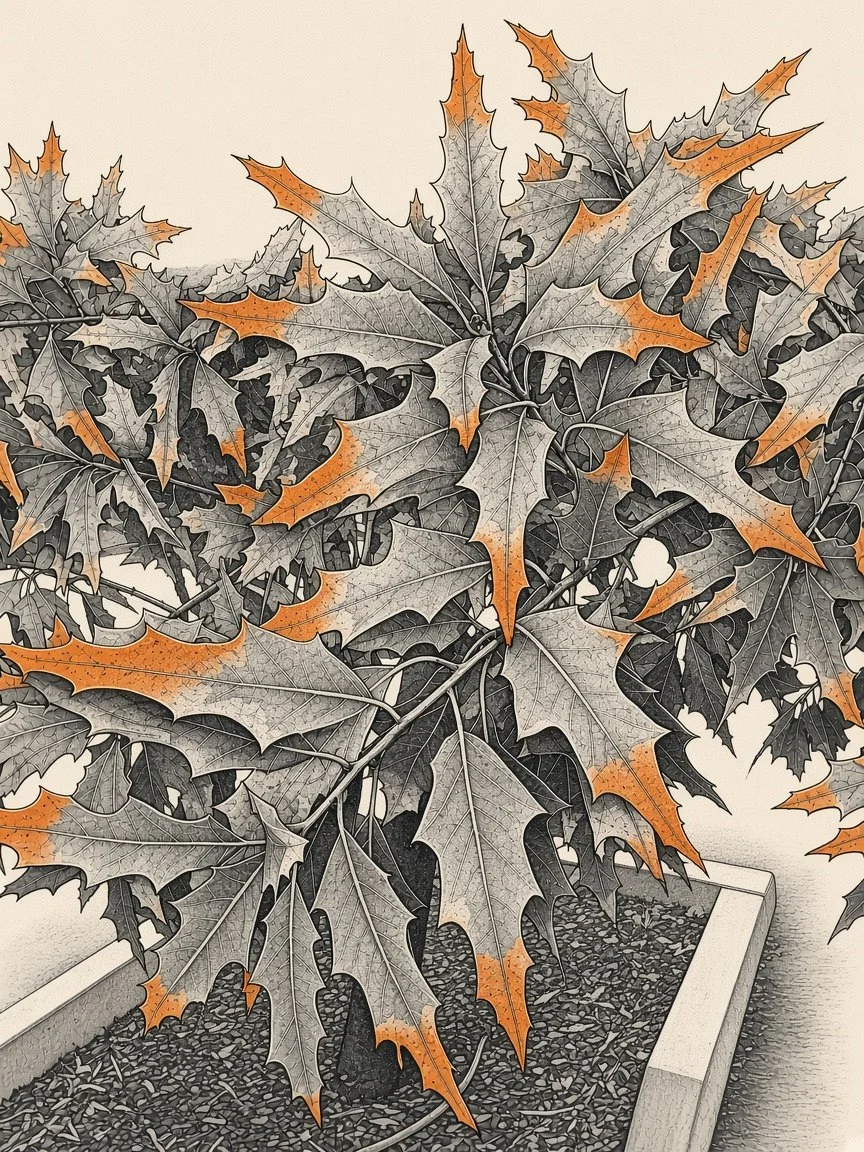
Young red oak in a small parking-lot planter, with tan, dead leaf tips and margins on otherwise green leaves. Speculative: heat and salt scorch from a hot, root-limited planter; early fall browning is a look-alike to rule out.
