
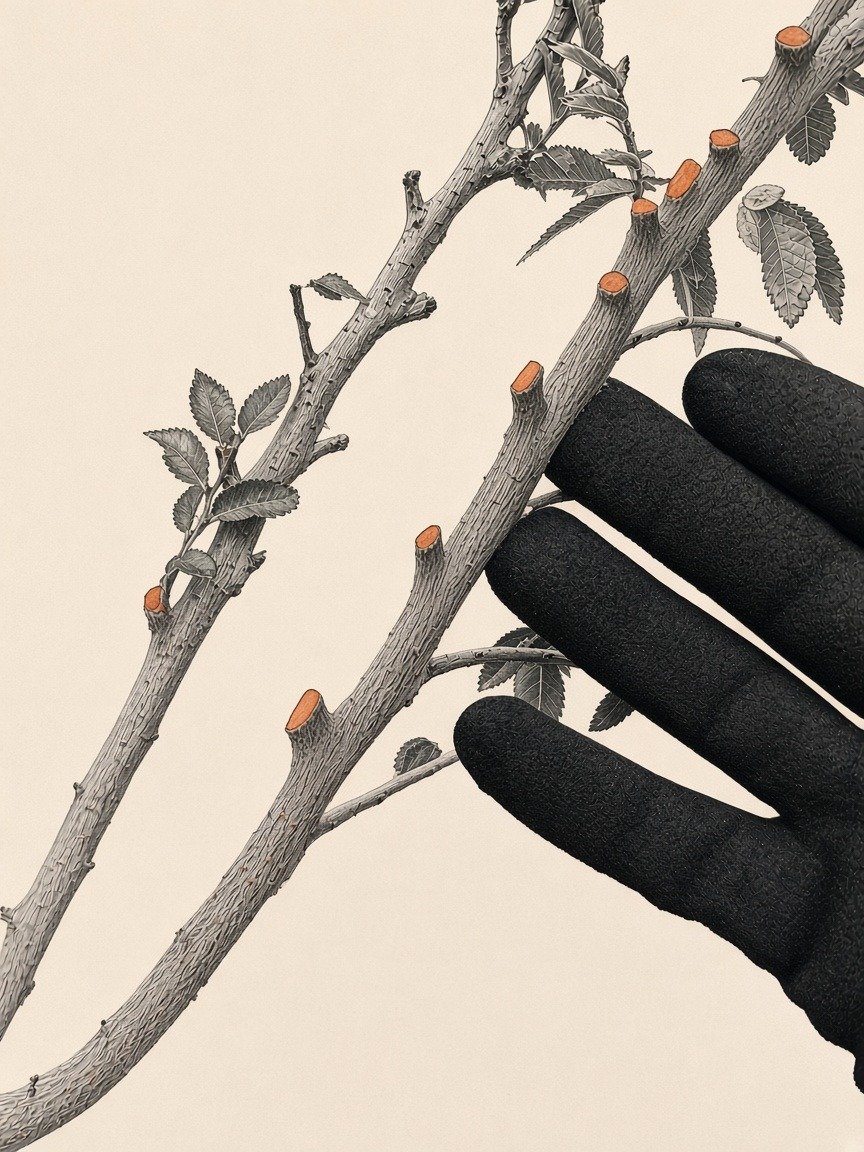
Chinese elm branch with short stubs where interior sprouts were cut off, leaving foliage mainly at the tips.
Summary
Lion-tailing, or stripping the interior, is when the side shoots and interior foliage are cut off along a limb, leaving leaves mainly at the tips. This Chinese elm branch shows that pattern clearly: stub after stub where interior sprouts were removed. It is a common pruning habit, and a poor one.
The tree loses the interior foliage that helps shade the bark and feed the limb. The growth that remains is tip-heavy and more likely to break. You cannot put those sprouts back on, but you can stop stripping and prune more carefully from here.
Key symptoms
- A long stretch of bare branch with many short stubs from cut laterals.
- Foliage concentrated at the branch tips rather than along the limb.
- On a whole tree, an open, see-through interior.
- Sometimes sunburned bark on limbs that were suddenly exposed.
- Weak, fast shoots may later sprout from the stubs.
Likely causes, ranked
- Improper thinning that removes interior growth instead of shortening a limb or taking it off at its origin.
- A habit of “cleaning up” sprouts along the stem to make the tree look tidy in the short term.
- Thinning for light or clearance done by cutting laterals off the remaining limbs, rather than by removing selected branches at the collar.
Look-alikes and how to tell them apart
- Proper thinning: a few well-chosen limbs are removed at the branch collar, and interior foliage is left on the limbs that remain.
- Seasonal leaf drop: leaves fall, but you would not see a row of cut stubs along the branch.
- Other poor cuts such as stubs, flush cuts, and heading cuts (see the Improper Pruning Cuts guide).
What to check on site
- How much of the canopy was stripped, not just a single branch.
- Bark scorch on newly exposed limbs, especially on the south and west sides.
- The weight and attachment of the remaining tip growth.
- Sprouts at the stubs, and whether they are weakly attached.
- Other cut quality: flush cuts, stubs, or heading cuts on the same tree.
Treatment
- Do not strip any more interior growth.
- You cannot restore the foliage that was removed. From here, prune only as needed: take out dead, broken, or poorly attached wood with cuts at the collar.
- Do not heading-cut the remaining tips as a way to “fix” the lion-tailing.
- Some sprouts that come back on the stubs can be selected and trained over time; many will be weakly attached and should be monitored.
- Watch exposed bark for sunscald. Newly opened limbs can burn in Tucson sun.
- Plan structural pruning with an arborist rather than another round of interior stripping. Good pruning removes a modest amount of foliage, keeps interior growth, and shortens or removes whole limbs at their origin.
What to expect and how to monitor
- The limb may sprout from the stubs. Those sprouts are often weakly attached and can break in wind.
- Exposed bark may sunburn over the next season.
- A fuller interior, if it returns at all, takes time and careful follow-up pruning. Some of the damage is permanent.
When to call TIMBERx
Call an arborist if a tree has been stripped or lion-tailed, or before a heavy thinning, so the canopy can be pruned in a way the tree can live with.
