
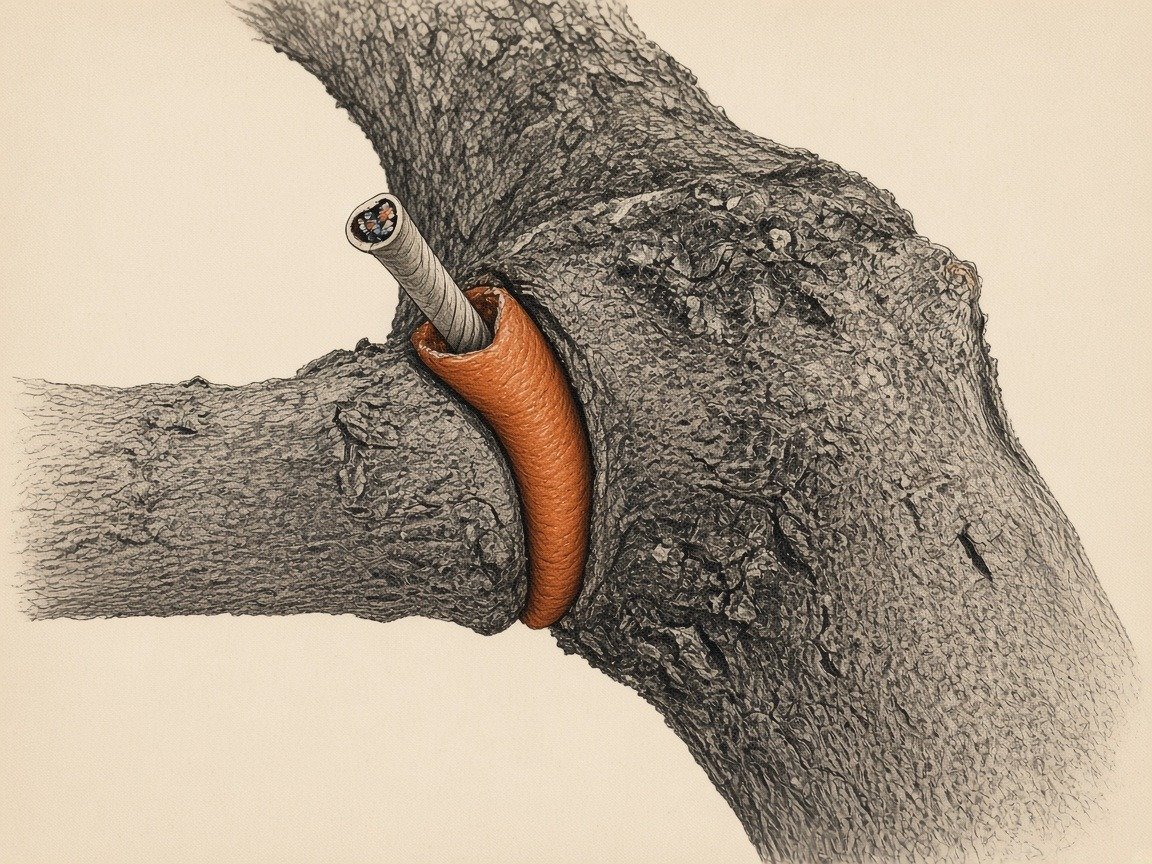
CAT 5 network cable deeply embedded in a branch crotch, with the limb swollen around a sharp groove.
Summary
A cable, wire, or tie left on a branch will not stretch as the limb grows. The branch adds wood around it. The material cuts into the bark and the water-conducting layer just under it, and the limb is girdled.
In this case, a CAT 5 network (ethernet) cable was left wrapped around a branch long enough that the wood has grown over it and the constriction is severe. That weakens the limb, and it is a common place for the branch to break. Low-voltage wiring, lights, and cables strung on or around trees get forgotten and girdle branches as they grow. The same problem happens with forgotten stake ties and wire on trunks (see the Trunk Girdling from Wire & Ties guide). Here it is a leftover CAT 5 cable on a branch, already deeply engulfed.
Key symptoms
- A cable, wire, or similar material wrapped around a branch, or a deep groove where one has been swallowed by the wood.
- Swelling of the limb on both sides of the ring.
- A sharp crease or cut in the bark at the cable.
- At a crotch, the cable can be pinched tighter as both stems thicken.
- In advanced cases, cracks, dieback beyond the ring, or a break at the constriction.
Likely causes, ranked
- A cable or wire left on a limb. In this case it was a CAT 5 network (ethernet) cable. Low-voltage wiring, lights, and other cables strung on or around trees often get forgotten.
- The tree kept growing; the material did not.
- Placement at a crotch, where two stems thicken and clamp the cable even tighter.
Look-alikes and how to tell them apart
- Stake ties and nursery tape on a trunk: the same girdling process, usually lower on the tree (see the Trunk Girdling from Wire & Ties guide).
- A natural bark ridge or graft union: a ridge without a groove and without material in the wood.
- Girdling roots: constriction at or below the soil line from a root, not a cable.
What to check on site
- Every main limb, including high in the canopy and at crotches, for cable, wire, hose, or ties.
- How deeply the material has been engulfed.
- Swelling, cracks, dieback, or poor growth beyond the ring.
- Whether the weakened point is over a house, wall, or walkway.
- Other leftover ties or wire elsewhere on the tree.
Treatment
- Cut away what you can reach without gouging the bark. Do not rip an embedded cable out of the wood.
- If the cable is deeply buried, remove the loose parts and leave the pieces that are fully grown over, rather than carving into the limb.
- Assess the limb at the ring. If it is badly constricted and over a target, reduce the weight or remove the limb with a proper cut.
- Do not paint or seal the groove.
- Go through the rest of the tree and take off any other wire, ties, or cable before they cut in as far as this one has.
What to expect and how to monitor
- A limb that is only shallowly marked will often add new wood over the groove in a few seasons once the cable is gone.
- A severe ring, like this one, remains a weak point even after the loose cable is cut away. Watch it for cracks or further decline.
- Check the tree at later visits for other forgotten cable or ties.
When to call TIMBERx
Call an arborist if a cable or wire is grown into a branch, especially a large limb over a house or walkway. Do not try to tear it out of the wood.
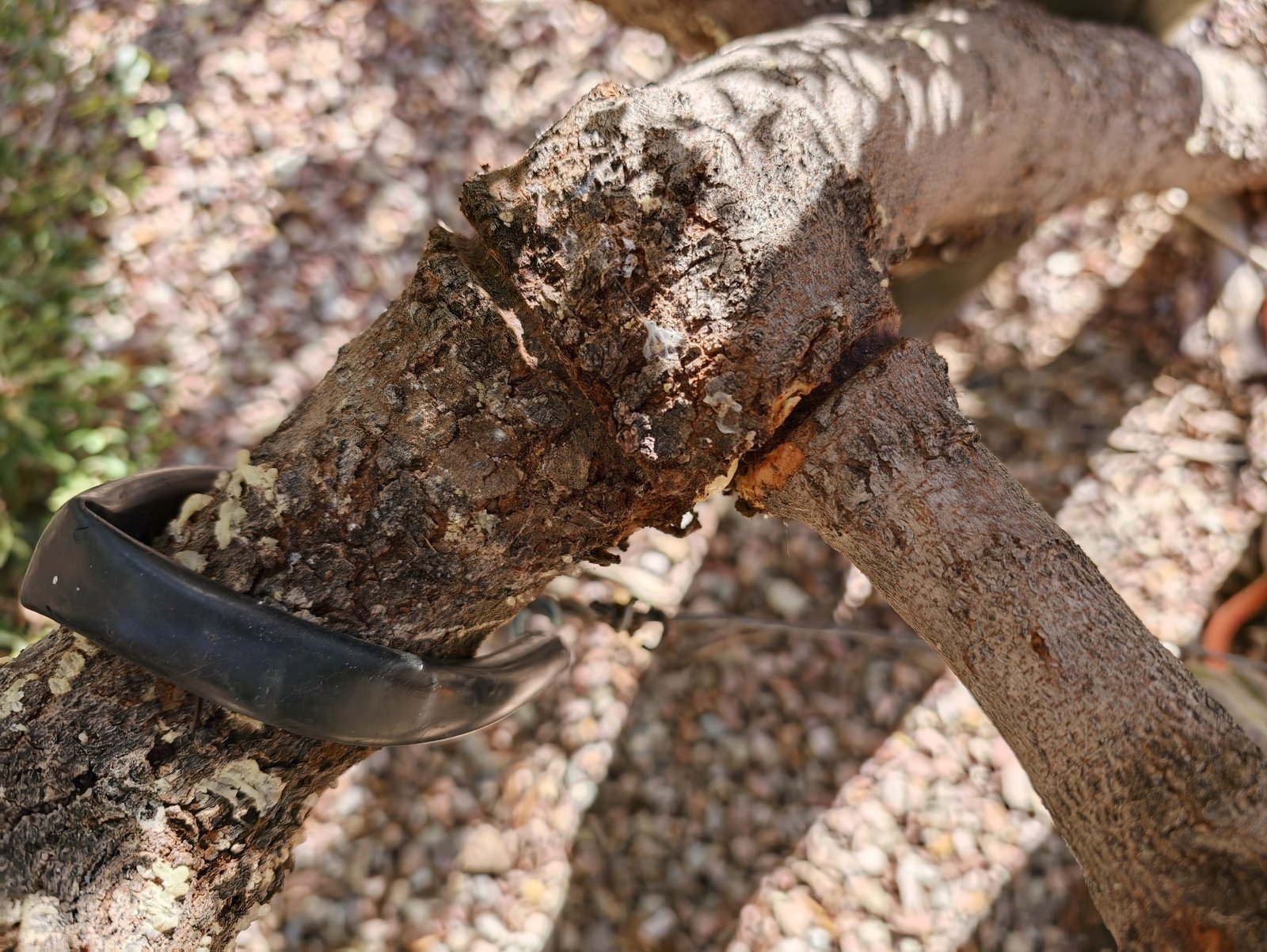
The same branch from another angle, showing how far the cable has been engulfed.
