

Desert landscape tree (species not confirmed) where a large limb has broken off, leaving a jagged, splintered stub with torn wood.
Summary
A branch failure is a limb or stem that breaks or tears away, usually during monsoon winds, under the weight of a heavy, over-extended limb, or at a weak union. Torn stubs and ragged wounds heal poorly and invite decay, so the cleanup and the reason it broke both matter. Most failures in Tucson trace back to structure: long, end-heavy limbs, codominant stems and old decay.
Key symptoms
- Jagged, splintered stubs or long bark tears where a limb broke.
- Fresh pale wood (recent) or grey, weathered wood (old).
- Broken limbs on the ground or hanging in the canopy.
- Cracks in nearby unions or limbs that are still attached.
Likely causes, ranked
- Wind loading on over-extended or end-heavy limbs, especially fast-growing desert trees like mesquite and palo verde.
- Weak unions with included bark (see Codominant Stems & Included Bark guide).
- Internal decay or cavities at the break point (see Wood Decay Fungi guide).
- Over-thinning or lion-tailing that leaves weight at branch ends.
- Drought stress and dieback, leaving brittle dead wood.
Look-alikes and how to tell them apart
- Pruning cuts: clean, flat cut surfaces, not torn wood.
- Self-pruning of dead twigs: small shaded branches dropping naturally inside the crown.
- Bark damage from impact: bark scraped off but the limb still attached.
What to check on site
- Look at the broken surface for decay, cracks or included bark.
- Check similar limbs in the canopy for the same weakness.
- Look for hangers (broken limbs still lodged in the tree).
- Assess targets below: people, house, vehicles, sidewalk.
Treatment
- Clean up broken stubs with a proper pruning cut back to a lateral branch or the branch collar. Don't leave jagged stubs.
- Remove hangers and cracked limbs promptly.
- Structural pruning to reduce long, heavy limbs and balance the crown, without lion-tailing.
- Do not paint or seal the wounds.
- If decay or a large wound is found at the trunk, get a risk assessment.
What to expect and how to monitor
- Clean cuts close faster than torn wounds; expect slow woundwood growth around the edges.
- Inspect before monsoon season and after big storms, especially trees that have failed before.
Worried about a tree? Text Justin, ISA Certified Arborist, at (520) 451-8790 or email Justin@TimberxTrees.com. TIMBERx serves Tucson, Oro Valley, Marana, Vail, Sahuarita, Green Valley and Benson.
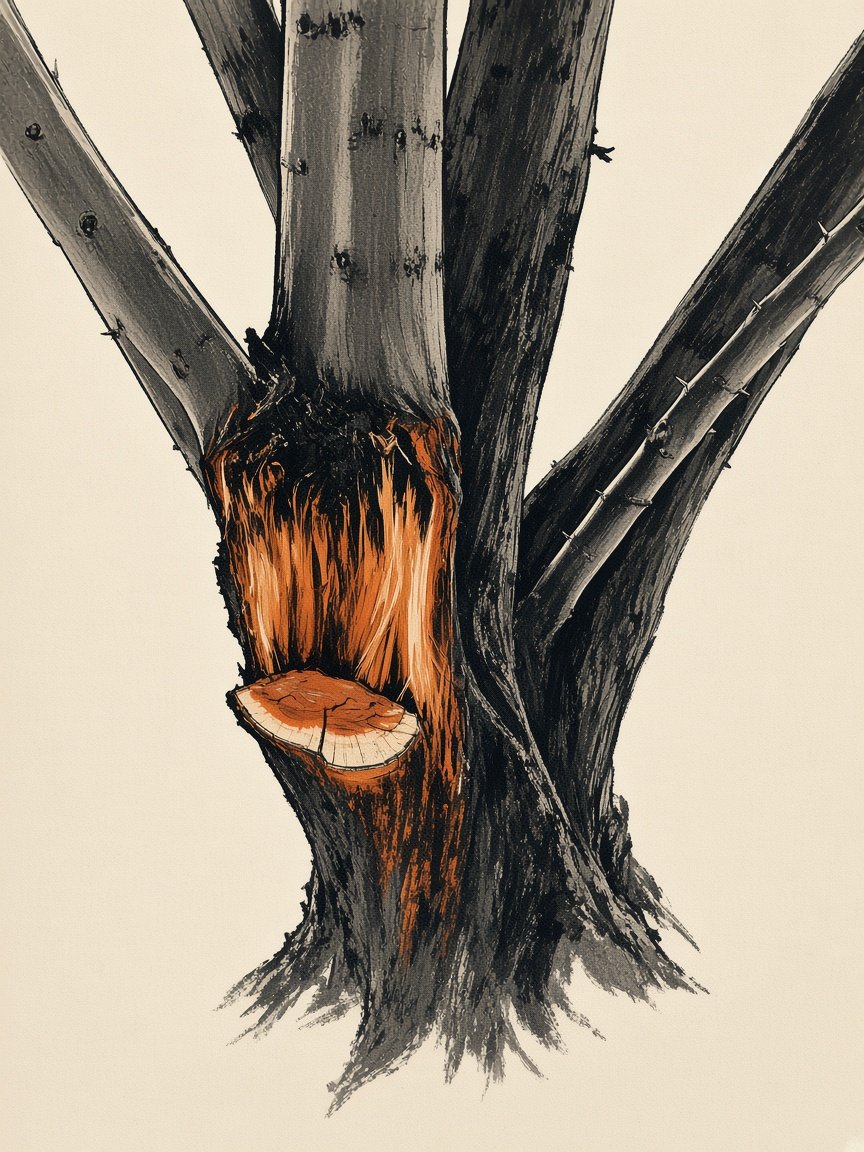
Multi-trunk tree where one stem tore out at the base, leaving a torn, splintered wound between the remaining stems.
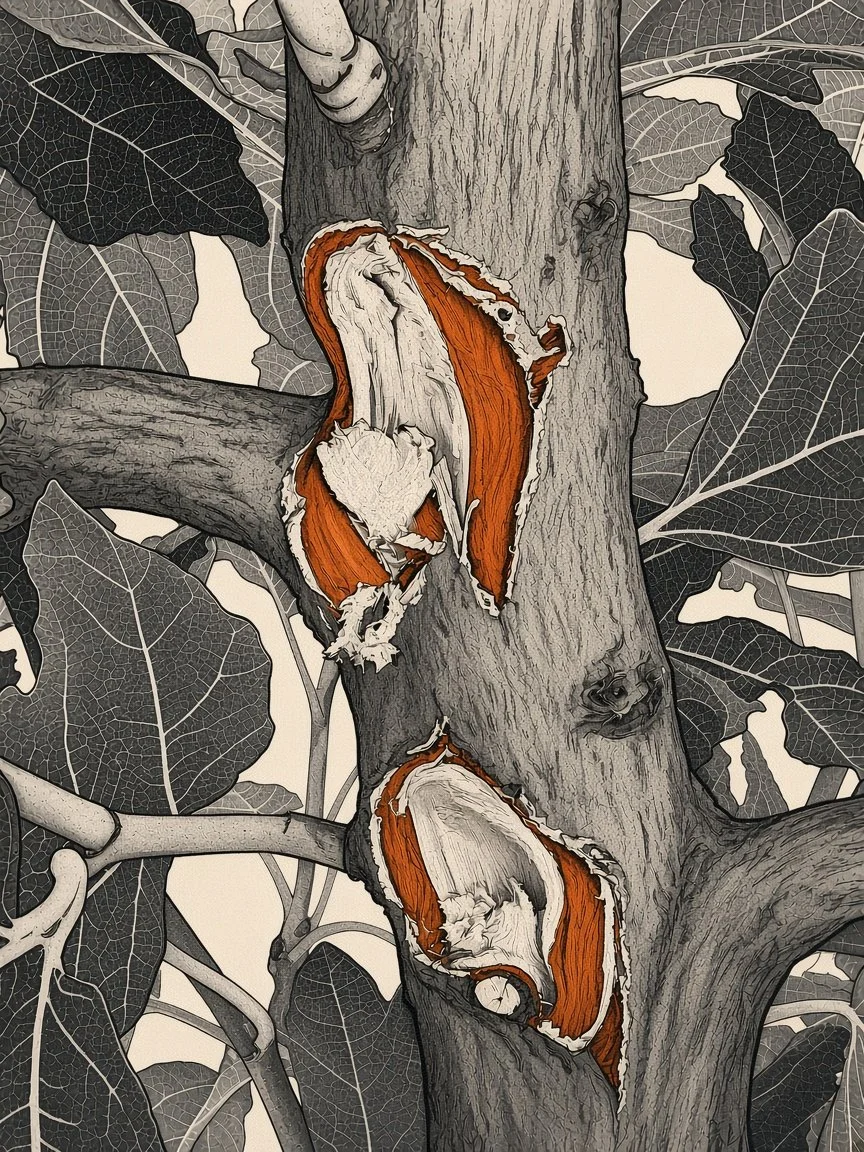
Fig (Ficus carica) with side limbs torn from the trunk, leaving ragged, stripped wounds where the bark peeled down the stem.
