

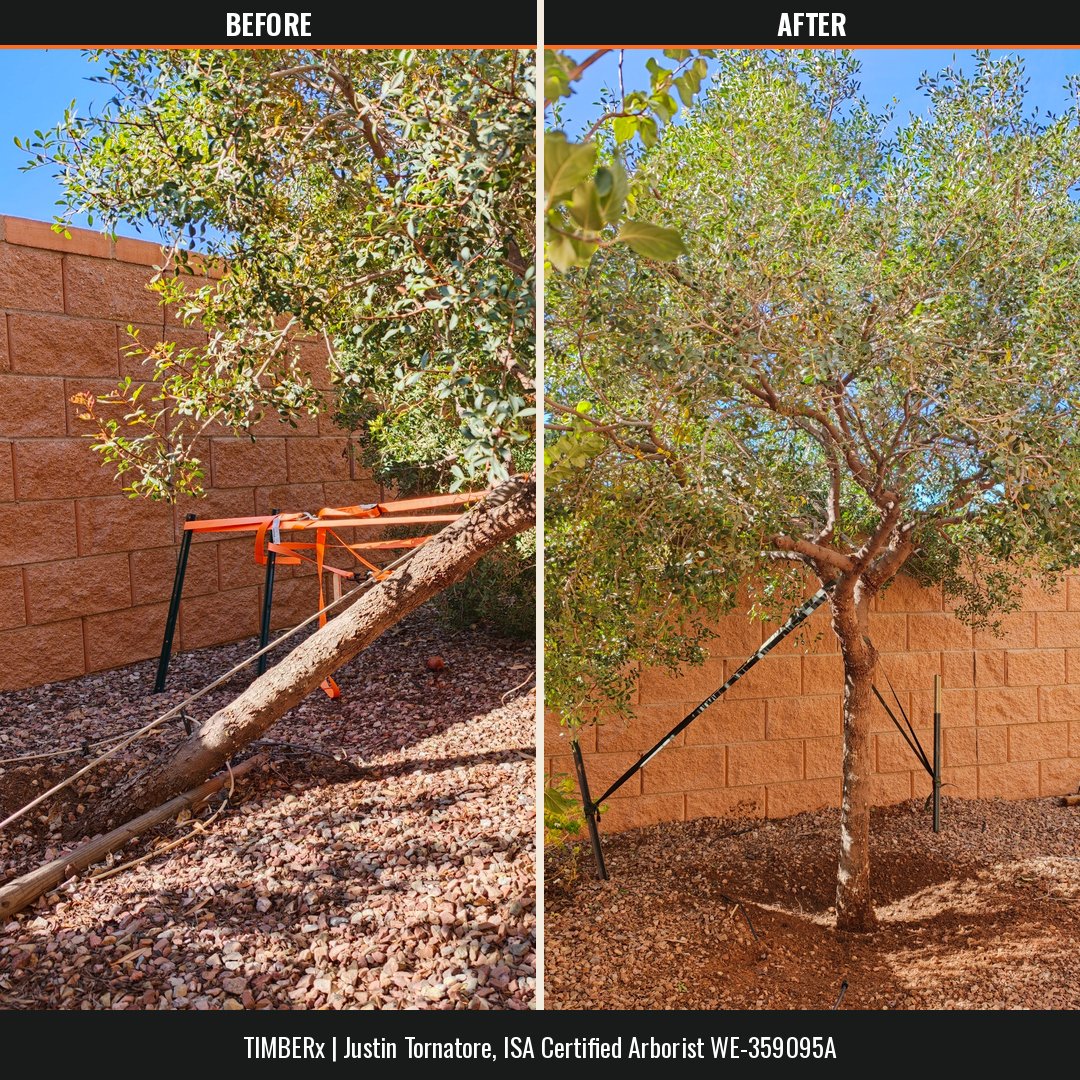
Mastic blown over to a steep lean, with disturbed soil at the base and temporary support holding the trunk.
Summary
A blowdown is a failure of the roots to hold the tree in the ground. It is not a trunk that snapped or a limb that tore out. Wind can push a tree over when the root system is too small, too shallow, or already damaged, or when wet soil lets the roots lose their grip.
This mastic was blown down to a steep lean. The canopy was still leafy, soil was disturbed at the base, and the tree had been temporarily propped and guyed. Whether a blown-over tree can be righted and saved depends on how much of the root system is still in the ground, how long it has been down, and whether the remaining roots can re-establish.
This tree was stood back up and guyed successfully. Two to three guy lines is typical, and three would have been the plan here. The mastic sat so close to the block wall that there was no room for a tie behind it, so two were used. The process is straightforward: stand the tree up, guy it with soft ties, and take the guys off after about one growing season.
Key symptoms
- The whole tree is leaning at a steep angle or lying over, often after wind.
- Soil at the base is cracked, mounded, or loosened, usually on the side opposite the lean.
- Roots may be pulled or exposed on the uplifted side.
- The canopy may still have leaves if the failure is recent.
- The trunk itself is not broken; the failure is at the root system.
Likely causes, ranked
- Wind loading on a crown the roots cannot hold, especially in monsoon or winter storms.
- A small, shallow, or circling root system from planting or a tight root ball.
- Wet or loose soil that lets roots lose their grip.
- Root damage from construction, trenching, or a change in grade.
- Decay in the roots or at the root collar that weakens anchorage.
Look-alikes and how to tell them apart
- Branch failure: a limb tears out, but the trunk is still standing (see the Branch Failure & Torn Limbs guide).
- Trunk breakage or a split stem: the failure is in the wood, not the roots.
- A slow lean from light or poor structure: no fresh soil cracking or lifted roots.
What to check on site
- How much of the root system is still in the soil, and how much has been pulled or exposed.
- Cracks or mounds in the soil, and whether the root collar is intact.
- How long the tree has been down; exposed roots dry out quickly.
- Temporary props and guy lines: are they actually holding the tree, and are they cutting into the bark?
- Targets if the tree settles further: a wall, house, or walkway.
- Irrigation lines and nearby roots that may have been pulled.
Treatment
- Recent blowdowns with a substantial root system still in the ground can sometimes be righted and guyed while new roots establish. Stand the tree up, guy it with soft ties, and remove the guys after about one growing season. The guying is temporary and should be checked and then taken off.
- Do not yank a large tree upright without a plan for the roots and for whatever sits in its path.
- If the roots are badly broken, dried, or decayed, or the tree cannot be made stable, removal may be the safe choice.
- Temporary props and guy lines should be padded so they do not girdle the trunk. They are not a permanent fix.
- After righting, keep the root zone evenly moist, not soggy, so remaining roots can grow. Do not pile soil over the root collar, and do not use heavy fertilizer to force recovery.
- Do not top the tree to “balance” it after a blowdown. Keep functioning foliage, and only remove broken wood with proper cuts.
What to expect and how to monitor
- If the tree is righted, new roots take time to form. Watch for wilting, dieback, or the lean returning.
- Recheck ties and anchors so they do not cut into the bark as the trunk moves or grows.
- A tree that was down for some time, or that keeps leaning after being stood back up, may not recover.
When to call TIMBERx
A blown-over tree is a stability and safety question, especially near a house, wall, or walkway. Call an arborist before trying to stand it back up.
