
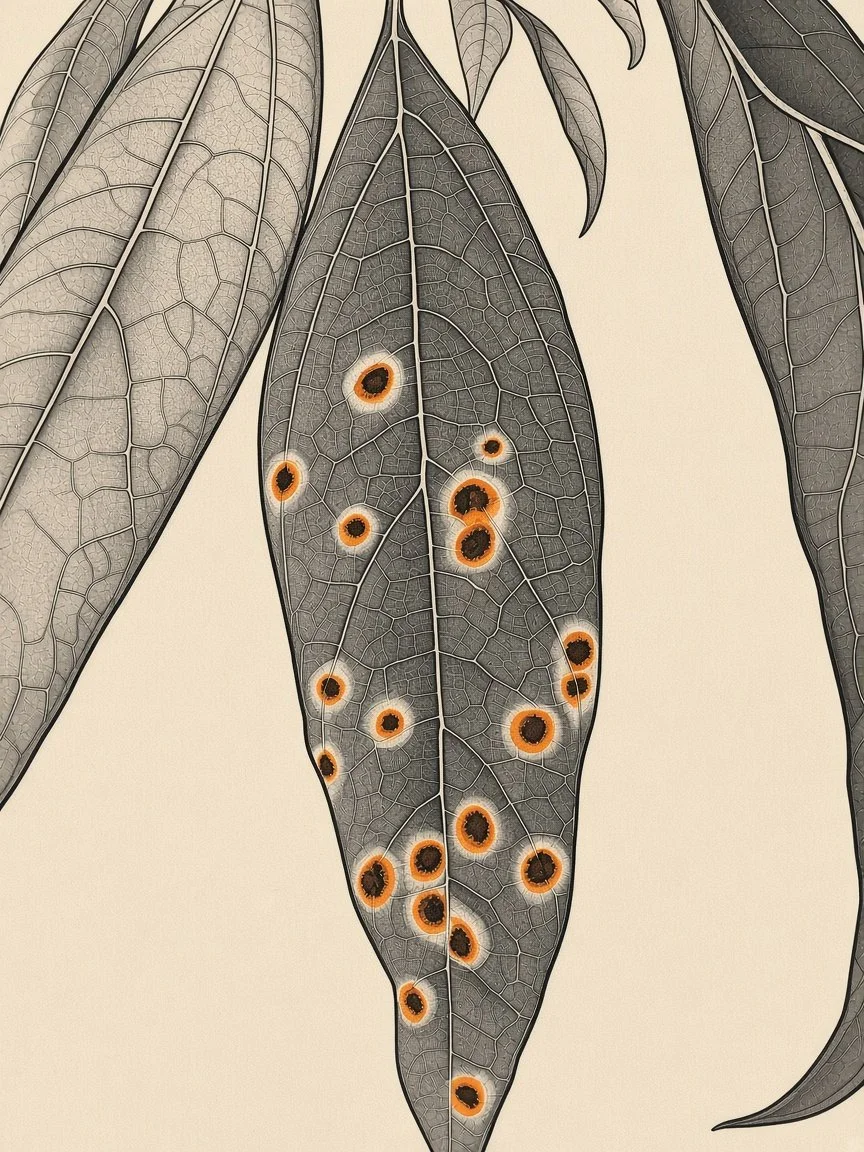
Broadleaf fruit tree (appears to be mango or avocado; confirm on site) with scattered brown, sunken spots ringed by yellow halos across the leaf. The trunk in the background is wrapped with wire, which should be checked as well (see Trunk Girdling from Wire & Ties).
Summary
Small brown or black spots with a yellow ring (halo) around them are a typical sign of a fungal or bacterial leaf spot. These diseases spread in splashing water and humidity, so in Tucson they show up most during and after monsoon season and on trees that get overhead sprinkler water. On established trees leaf spot is usually a cosmetic problem, but heavy infections on young or tropical fruit trees can cause leaf drop and weaken the tree.
Key symptoms
- Round to irregular brown or black spots, often with a yellow halo.
- Spots scattered across the leaf, sometimes merging into larger dead patches.
- Worst on lower, shaded or crowded leaves that stay wet longest.
- Heavily spotted leaves yellow and drop early; on some fruit trees, spots also appear on fruit or young shoots.
Likely causes, ranked
- Fungal leaf spot or anthracnose. The most common cause; favored by warm, humid weather, rain and overhead watering.
- Bacterial leaf spot. Spots often look water-soaked or angular at first with a yellow halo; spreads in splashing water.
- Stress making leaves more susceptible. Poor air flow, dense canopy, nutrient imbalance or a tree that is marginal for our climate.
Look-alikes and how to tell them apart
- Salt or drip-water burn: browning at leaf tips and edges, not spots in the middle of the leaf (see Leaf Tip Burn - Salt Buildup & Drip Water Stress).
- Sunburn: large bleached or tan patches on the most exposed side of the leaf, without halos.
- Insect or mite feeding: tiny pale stippling, holes, or insects and webbing on the underside.
- Nutrient chlorosis: yellow patterns between the veins without dead spots.
What to check on site
- Look at both sides of affected leaves and young shoots with a hand lens for spots, fungal specks, insects or mites.
- Note whether new growth or only older leaves are affected, and whether fruit is spotted.
- Check for overhead sprinklers, splashing drip, crowded canopy and poor air flow.
- Confirm the species and whether it is suited to our desert conditions.
- If it is spreading quickly, a sample to a plant diagnostic lab can identify the organism.
Treatment
- Sanitation: rake up and remove fallen spotted leaves; prune out heavily infected twigs with clean tools.
- Keep foliage dry: switch to drip or ground-level watering and water in the morning.
- Improve air flow: light thinning of crowded interior growth helps leaves dry.
- Copper or other fungicides can protect new growth on high-value fruit trees when applied before or early in wet periods; any product must be used exactly per its label and is not a cure for leaves already spotted.
- Keep the tree healthy: deep, infrequent watering and balanced feeding help it outgrow the damage.
What to expect and how to monitor
- Spotted leaves do not heal; success is clean new growth.
- Expect flare-ups in monsoon humidity; check new leaves through late summer.
- If spotting keeps spreading to shoots and fruit despite good care, have a sample tested to confirm the cause.
Worried about a tree? Text Justin, ISA Certified Arborist, at (520) 451-8790 or email Justin@TimberxTrees.com. TIMBERx serves Tucson, Oro Valley, Marana, Vail, Sahuarita, Green Valley and Benson.
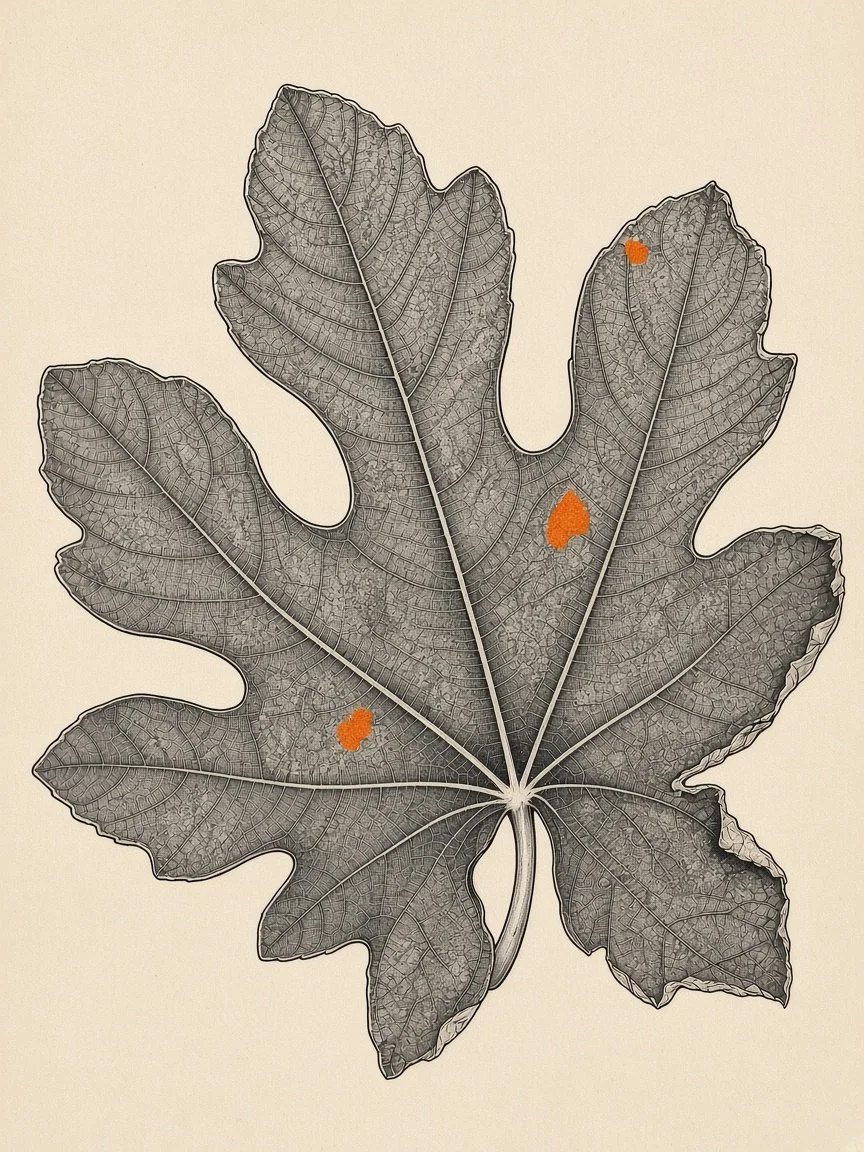
Fig (Ficus carica) leaf with dark brown blotches running between the veins and gray-white fungal growth on the oldest lesions. Speculative: a fungal leaf spot or leaf blight of fig; confirm with a lab sample before treating.
