
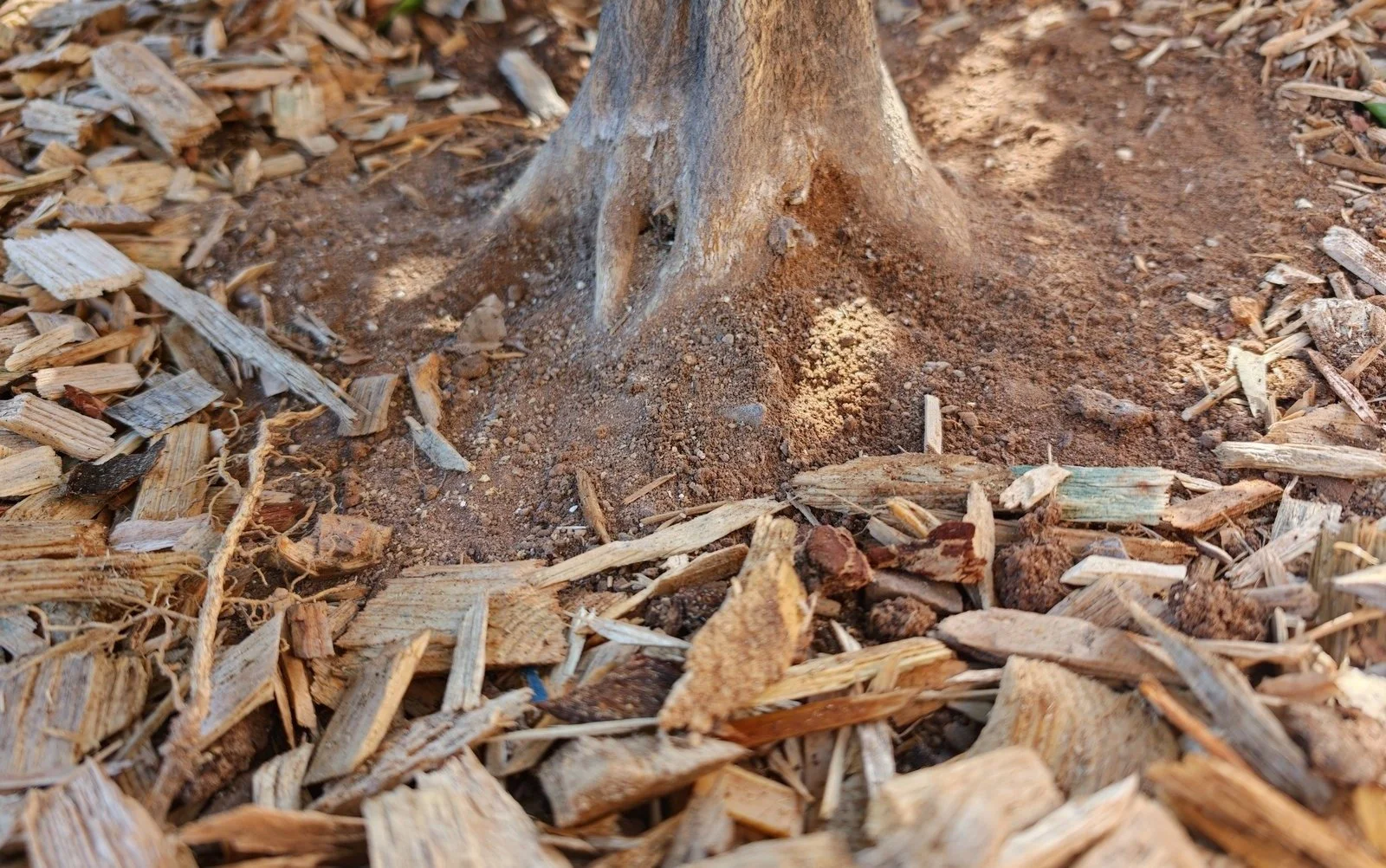
A grapefruit with a healthy root flare and well-developed buttress roots; wood-chip mulch is kept back from the trunk.
Summary
A healthy tree does not go into the ground like a telephone pole. At the base, the trunk widens into a flare, and large buttress roots spread out at or just above the soil line. That flare is where the tree is strongest, and where it exchanges air with the soil. This grapefruit is a clear example of that structure: the flare is visible, the buttress roots are well developed, and mulch is held back from the bark.
Planting depth is what usually decides this. A tree planted too deep, or later buried by soil or mulch, loses this flare from view and can go on to develop circling or girdling roots (see the Buried Root Flare and Girdling & Circling Roots guides). Keeping the flare visible is one of the simplest ways to give a tree a long, stable life in Tucson.
Key symptoms
- The trunk widens at the base instead of going straight into the soil like a pole.
- Buttress roots are visible at or just above grade, spreading away from the trunk.
- Mulch, soil, and rocks are kept off the bark of the flare.
- No roots are wrapping or cutting into the trunk at the collar.
Likely causes, ranked
- Planted at the right depth, with the root flare at or slightly above the finished grade.
- Mulch and soil kept off the trunk, in a wide ring that does not touch the bark.
- A root system that was not left circling from a tight nursery pot, so the main roots can spread naturally.
Look-alikes and how to tell them apart
- A buried root flare: the trunk enters the ground like a pole, with no widening at the base (see the Buried Root Flare guide).
- Girdling or circling roots: a root wraps across the collar or around the trunk (see the Girdling & Circling Roots guide).
- Mulch or gravel piled against the bark: the flare may be present but hidden. Pull the material back and look before deciding the tree was planted too deep.
What to check on site
- Whether you can see the flare all the way around the trunk.
- Whether mulch, soil, or irrigation emitters are piled against the bark.
- Whether any root is wrapping or pressing into the trunk at the collar.
- The planting depth of young trees, especially newly installed ones.
Treatment
- Keep the flare visible. Pull soil and mulch back so the widening at the base and the buttress roots stay in the open and dry.
- Mulch in a wide, shallow ring, a few inches away from the trunk. Do not build a mulch volcano against the bark.
- Keep drip emitters off the trunk. Water the root zone, not the flare.
- If your tree looks like a pole going into the ground, see the Buried Root Flare guide. An arborist can expose the flare and check for girdling roots.
- Do not add soil or grade changes over an already healthy flare.
What to expect and how to monitor
- A flare that is kept clear will stay visible as the tree grows, and the buttress roots will thicken with age.
- Mulch and soil creep back toward the trunk over time. Recheck once or twice a year and pull them back as needed.
- Watch for a root that begins to wrap the collar as the tree matures.
When to call TIMBERx
Call an arborist if you cannot find the flare, if mulch or soil is piled against the trunk, or if you see a root wrapping the base. A healthy flare like this grapefruit is the goal.
