

Dead trunk wood with the bark gone (species not confirmed), showing winding insect galleries etched into the wood surface and a round exit hole.
Summary
Wood-boring beetles lay eggs on bark; the larvae tunnel under it, feeding on the living layer and outer wood, then chew their way out as adults through a round or oval exit hole. In Tucson, borers almost always follow stress: drought, heat, sunscald, root damage or old wounds. Finding galleries means part of the tree was weakened before the insects arrived, so the cause of the stress matters as much as the beetles.
Key symptoms
- Round or oval (sometimes D-shaped) exit holes in bark or bare wood.
- Winding, sawdust-packed tunnels (galleries) under loose bark or etched into the wood.
- Fine sawdust (frass) at holes or in bark crevices; sap weeping on some species.
- Dieback or thinning above the affected area; bark that loosens and falls away.
Likely causes, ranked
- Borers attacking a stressed or dying tree or limb. The main pattern in desert landscapes.
- Sunscald or heat-damaged bark on the south and west sides, which borers favor.
- Old wounds and poor pruning cuts giving easy access.
- Recently transplanted or root-damaged trees that have not re-established.
Look-alikes and how to tell them apart
- Sapsucker holes: neat horizontal rows, not scattered (see Sapsucker Damage guide).
- Termite damage: mud tubes and soil-packed galleries, usually in already dead wood near the ground.
- Natural bark cracks: no holes, galleries or frass.
What to check on site
- Exit hole size, shape and freshness (clean edges and fresh frass mean active).
- How much of the trunk or limb is affected; lift loose bark to see galleries.
- Canopy dieback above the damage.
- Watering, sun exposure on the trunk, root disturbance and old wounds.
- Whether the wood is still structurally sound or a failure risk.
Treatment
- Remove dead and heavily infested limbs and dispose of the wood off site or chip it; don't stack it near other trees.
- Fix the stress: deep, infrequent watering, protect the root zone, and avoid heavy pruning that exposes bark to sun.
- Insecticides have a limited role and mostly as prevention on high-value trees; any product must be used exactly per its label. Once larvae are deep in the wood, sprays do little.
- Assess structure: if the main trunk is extensively tunneled and the tree is near a target, removal may be needed.
What to expect and how to monitor
- Damaged wood does not recover; success is no new exit holes and healthy new growth.
- Check each spring and late summer for fresh frass and holes.
Worried about a tree? Text Justin, ISA Certified Arborist, at (520) 451-8790 or email Justin@TimberxTrees.com. TIMBERx serves Tucson, Oro Valley, Marana, Vail, Sahuarita, Green Valley and Benson.
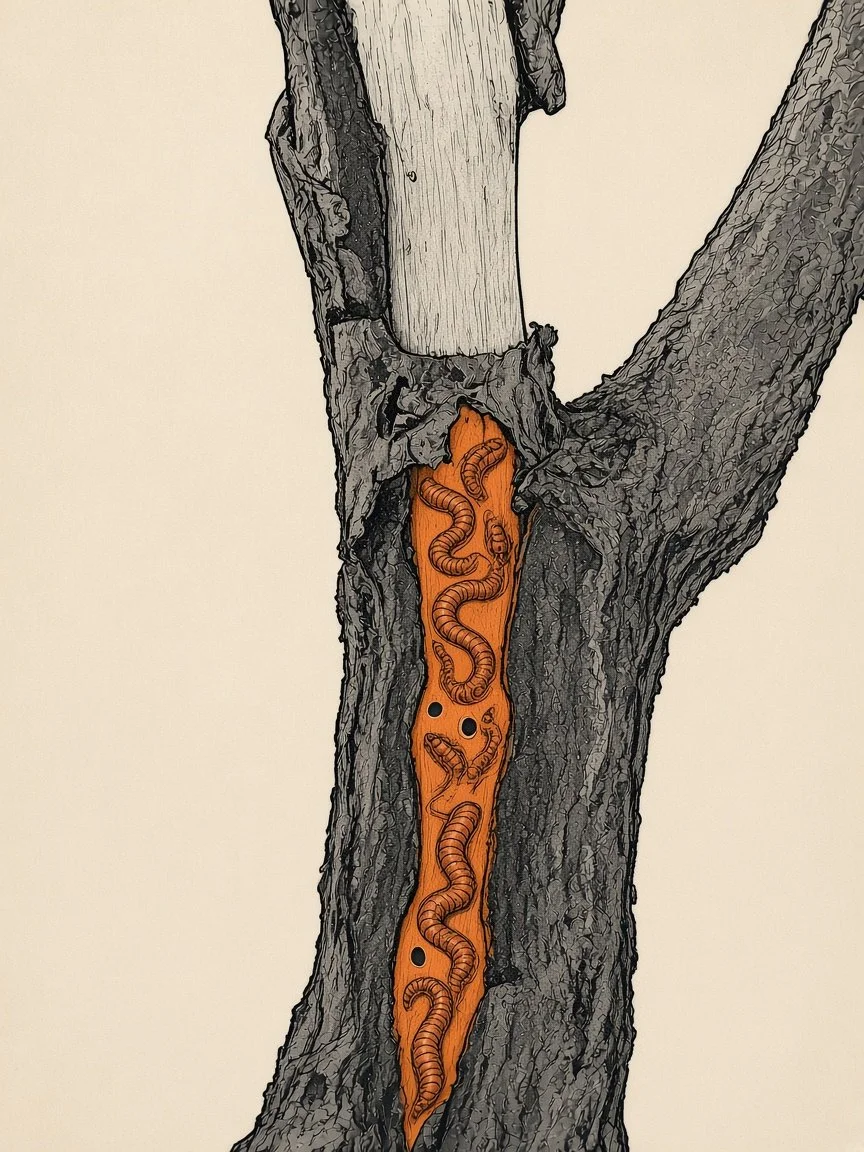
Trunk of a landscape tree (species not confirmed) with a long strip of dead bark gone; the bare wood shows round exit holes. The strip pattern is typical of sunscald that borers then attack.
