
Written by Justin Tornatore, ISA Certified Arborist | TIMBERx
Abstract
Every monsoon season, three-inch beetles start crashing into porch lights across Southern Arizona, and every year homeowners ask whether these "palo verde beetles" are killing their trees. The palo verde root borer is the larval grub of a large longhorn beetle (Derobrachus species) that feeds on the roots of palo verdes and many other broadleaf trees for three or more years before emerging as an adult [1][2]. University of Arizona Cooperative Extension sources agree on two key points. First, there are no effective control measures. Second, the grub is often blamed for deaths that actually start with tree stress [1][2][3]. This article reviews the beetle's biology, what the extension literature says about the damage it causes, and why good watering and planting practices are the best defense.
Background: Meet the Beetle
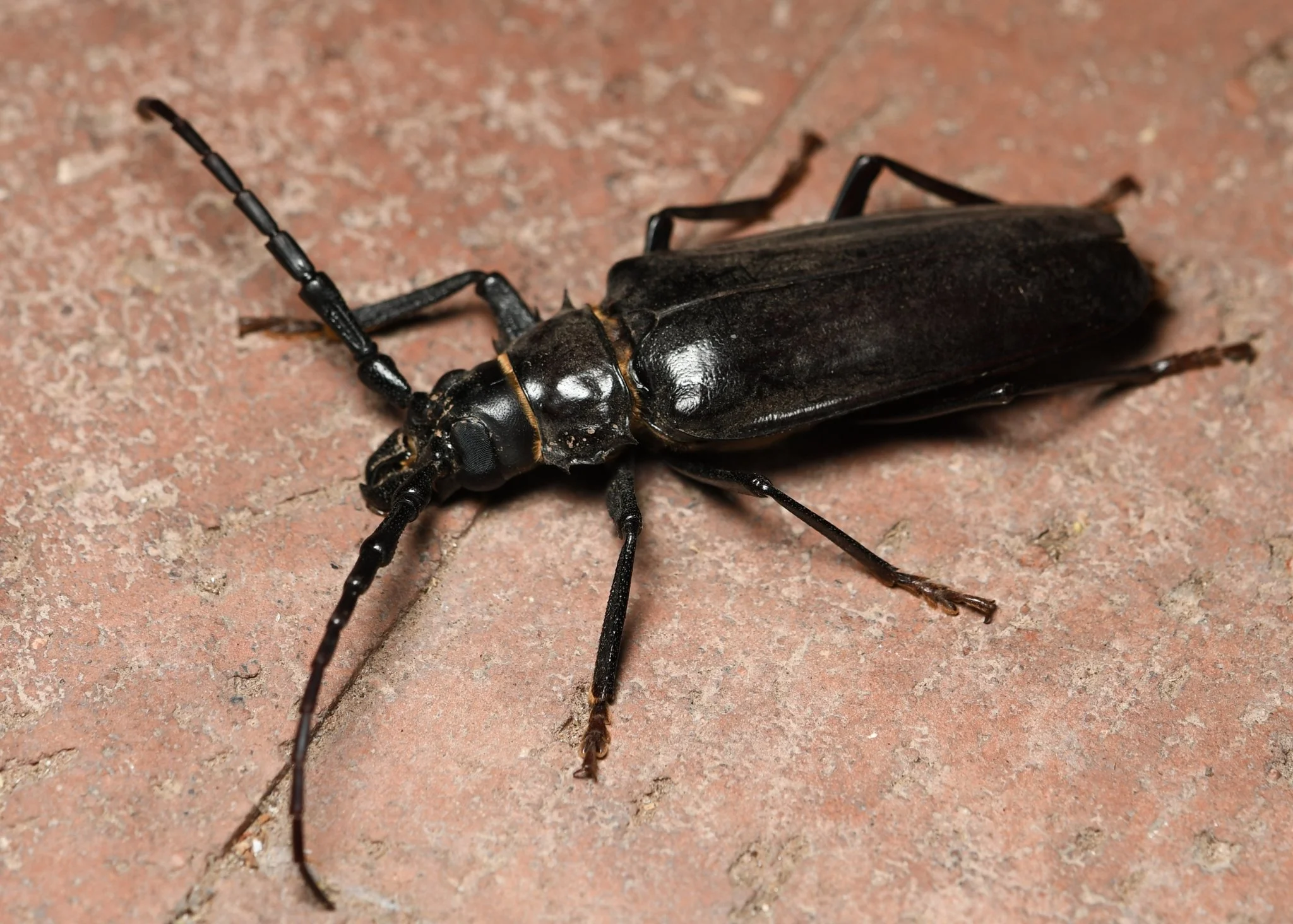
The adult palo verde beetle is hard to miss. It is 3 to 3.5 inches long, dark brown to black, with antennae about half the length of its body [1]. Adults emerge from roughly one-inch-wide holes in the soil during the summer rains [1], and they're usually seen from early summer through the hot months [2]. If you've seen them buzzing around at night, that's normal. They're active mainly after dark and attracted to light, which is why so many end up dead on porches or under lit windows [2].
The name on the label has changed over the years. UA's Mesquite and Palo Verde Trees for the Urban Landscape lists the species as Derobrachus geminatus [1], while a 2021 University of Arizona article uses Derobrachus hovorei [4]. A Pinal County Extension agent notes the beetle "has had several scientific names over the years as scientists have studied them" [2]. Whatever the name, the biology is the same.
The life cycle, in brief:
- Adults don't eat. They live off energy stored during the larval stage, survive up to about a month, and exist to mate and lay eggs [2][4].
- Eggs are deposited in the soil beneath host trees, about two to three inches deep [2].
- Larvae (the grubs) find the root system, bore into roots large enough to hold them, and feed toward the trunk crown for three or more years. Full-grown grubs reach three to four inches [2], and UA describes them reaching up to five inches [1].
- Pupation and emergence follow, with adults usually appearing in June and July [2].
Despite the name, palo verde isn't the only host. The Pinal County newsletter lists mesquites, roses, privets, elms, cottonwoods, mulberries, citrus, and stone fruits. It also notes the grubs don't seem to feed on palms, agaves, bamboo, or other plants with parallel-veined leaves [2].
What the Research Shows
The damage is real, but it's underground. Because the grubs feed for years and grow large, they can consume a significant amount of root tissue. The classic symptom is large branches dying back, often all the way to the trunk, one branch at a time [2].
Healthy trees often outgrow it. Unless a tree's roots host many larvae, symptoms may never show above ground. A healthy plant can usually produce enough new roots to offset the feeding [2].
Stress invites the borer, not the other way around. UA's 2021 article states plainly that root borers "are frequently and erroneously blamed for killing palo verde trees," and that trees more likely die or are damaged "due to stress and other environmental factors" [4]. The Pinal County agent describes emerging evidence that stressed trees may give off odors that attract wood-consuming insects, so decline may be "hastened, and not necessarily caused" by the borer [2]. This matches the broader pattern UA describes for wood borers in general: most can attack only dying trees or trees under stress, and in Arizona that stress usually comes from inadequate irrigation, though mechanical injury, root disturbance, sunscald, and disease also contribute [3].
There's no spray for this. UA's urban landscape publication states that "no control measures are recommended" [1]. The Pinal County newsletter explains why. Contact and soil-applied insecticides can't reach grubs inside a root, and systemic insecticides "don't seem to work very well either" [2].
Why the grub gets the blame. When a dead palo verde is removed, the grub is usually found in the roots, which is how the insect got its name [1]. Finding a suspect at the scene isn't the same as proving it did the deed.
Field Observations
I like to explain borers the way a doctor might explain an opportunistic infection. The germ shows up when the patient's defenses are already down. When a palo verde or mesquite declines and grubs turn up during removal, I look backward at the tree's history. Was the irrigation changed or cut off? Were roots severed for a wall, a pool, or a trench? Was the tree planted too deep? UA notes the foothill palo verde is extremely susceptible to deep planting or soil piled against the base of the trunk [1]. Was the canopy heavily cut, leaving bark exposed to the sun? Those questions usually tell more of the story than the grub does.
Homeowners also tend to worry about the adults. The beetles are startling, but the Pinal County agent describes them as relatively harmless. They can bite if a finger gets close to their jaws, and if you need to move one, grab it behind the head [2].
Practical Recommendations
- Don't spray. Insecticides aren't effective against grubs inside roots [2], and treating the soil just adds cost and chemicals without solving the problem.
- Water for deep roots. Water slowly and deeply out at the dripline, not at the trunk, and let the soil dry between irrigations [1][5]. A vigorous tree that can outgrow root feeding is the best defense available [2].
- Protect the root zone. Avoid trenching, grade changes, and compaction under the canopy, and keep the root flare exposed. Root disturbance is a known stress trigger for borers [3].
- Prune conservatively. Heavy pruning exposes bark to sunscald, another stressor linked to borer activity [3]. Stay well under 25% of the canopy at any one time [6].
- Watch for one-branch-at-a-time dieback. If major limbs are dying back to the trunk in sequence, have the tree evaluated, keeping in mind that the borer may be a symptom of a larger problem [2].
- Think about replanting. Grubs may move to a nearby susceptible plant after a host dies or is removed. The Pinal County agent suggests replanting a palm or agave in that spot [2].
Key Takeaways
- The palo verde root borer feeds underground for three or more years and attacks many broadleaf trees, not just palo verdes [2].
- No insecticide or control measure is recommended or effective [1][2].
- UA researchers consider tree stress the more likely root cause of decline, with the borer hastening it [3][4].
- Your best tools are a hose and a shovel: deep, correct watering and a protected, properly planted root zone.
Happy (and beetle-proof) planting, friends!
Talk to an Arborist
Seeing dieback in a palo verde or mesquite? Text Justin at (520) 451-8790 (texting is preferred over calling) or email Justin@TimberxTrees.com. TIMBERx is a veteran-owned tree care company led by Justin Tornatore, ISA Certified Arborist, serving Tucson, Oro Valley, Marana, Vail, Sahuarita, Green Valley, and Benson.
References
- Schuch, U., & Kelly, J. (2012). Mesquite and Palo Verde Trees for the Urban Landscape (AZ1429). University of Arizona Cooperative Extension. https://extension.arizona.edu/publication/mesquite-and-palo-verde-trees-urban-landscape
- Gibson, R. D. (2019). Palo Verde Root Borers. July 2019 Garden & Landscape Newsletter. University of Arizona Cooperative Extension, Pinal County. https://extension.arizona.edu/sites/extension.arizona.edu/files/attachment/july-2019.pdf
- Schalau, J. (adapted 2023). Borers in Landscape Trees (Backyard Gardener #52). University of Arizona Cooperative Extension, Yavapai County. https://extension.arizona.edu/sites/extension.arizona.edu/files/attachment/Borers_0.pdf
- Brandt, R. (2021). Bug Bonanza: 7 Big, Colorful Critters to Try to Spot This Monsoon Season. University of Arizona News. https://news.arizona.edu/news/bug-bonanza-7-big-colorful-critters-try-spot-monsoon-season
- Call, R. E., & Daily, C. (2017). Watering Trees and Shrubs (AZ1298). University of Arizona Cooperative Extension. https://www.extension.arizona.edu/publication/watering-trees-and-shrubs
- Larson, P., Vance, L., & North, D. (2025). July Monthly Gardening Guide for Pima County. University of Arizona Cooperative Extension. https://www.extension.arizona.edu/publication/july-monthly-gardening-guide-pima-county
